

Catholic seminaries have several deficiencies. Despite the highly-trained Ghanaian personnel who staff these seminaries, a truly Ghanaian theology is not likely to emerge in the near future. A visit to the libraries of these seminaries shows the relatively low academic commitment.
He paused briefly and continued reading:
Although at the time of the creation of five new dioceses it was claimed that this was required by the growth of the church, it may be that the Catholic Church is not growing but in fact losing numbers. The Ghana Evangelism Committee surveys showed that attendance decreased by 2% between 1986 and 1993. So although the significance of the Catholic Church cannot be denied, it is also true that its growth is not unchecked.
Where had I read those lines before? Ah, Paul Gifford. He was quoting Gifford’s 1998 publication, African Christianity: Its Public Role. Gosh, were those words penned that long ago, I mused. It was remarkable to consider these views were three years short of thirty years old, yet still possessed a pungent pertinence. As Gifford had presciently predicted, a distinctly Ghanaian theology was non-existent, notwithstanding the steady stream of clerical PhDs emerging from impressive learning centres at home and abroad. Even the fascinating initiatives in inculturation, championed by indigenous ecclesiastical leaders like Archbishop Amissah and Sarpong, and Cardinal Dery, had barely blossomed beyond their initial input and influence, with little theological engagement to anchor the liturgical forms that such innovations usually took. As for declining numbers, that was now a ceaseless lament, a plaintive litany almost beginning to sound like a broken record. My musing was brusquely interrupted.
Aren’t there research centres at Ghana’s Catholic seminaries? Baafour asked. Without waiting for an answer, he continued: The Trinity Theological Seminary at Legon has a number. If I remember correctly, there are the Institute of Women and Culture, the Centre for Mother Tongue Biblical Hermeneutics, and the Centre for the Study of Christianity in Africa—three specialist centres, Baafour stated enthusiastically.
The man I had ascribed the moniker Garrulous Impertinence only shook his head. He seemed genuinely disappointed. He sighed and shrugged his shoulders. Then, with uncharacteristic contemplative softness, he stated:
Succession appears to be a critical challenge facing the Catholic Church in Ghana. However, there is hope in the form of mentorship. Instead of Cardinal Turkson ascending to the papacy, his role in preparing the next generation of Catholic Church leadership in Ghana, as Archbishop Amissah did for him, could be a game-changer for the church’s future.
Still maintaining the pretence of reading, I pondered the gentleman’s comments. Succession and tradition had more than a rhyme. The connection between tradition and succession was accurately hinged on mentorship, the process through which the rich wealth of experience would be shared with the emerging leadership of both the present and future. Who better to perform this necessary service for church growth in Ghana than leaders who had honed the art and skill of ecclesial governance through decades of exceptional service, both at home and abroad? Indeed, better a cardinal relevant in Ghana by his advocacy for civic virtue and environmental conversion than a pope propped up on a global stage whose homeland lay impoverished by unethical citizens and polluted waters.
For the second time, my intellectual reverie was rudely interrupted. This time it was from the flight deck. With typical indistinctness, the pilot notified the cabin crew to prepare for landing. Now, frightfully, Garrulous Impertinence turned to me.
That was your point exactly, wasn’t it? Surely, that’s what you had in mind when you wrote these lines in the third part of your article on the 75th anniversary of Ghana’s Catholic hierarchy: “How the wisdom of decades of episcopal experience passes on to the next generation of Ghana’s Catholic Church leadership is a matter of interest. What structures are in place or may need to be developed to facilitate effective mentoring of Ghana’s upcoming Catholic leaders, recalling that in this era of synodality, such formation should target not only their brother bishops and priests but also the laity.”
I mumbled something – so much for my attempt to feign disinterest. The gentleman knew me, after all. I was both embarrassed and enthused that he recognised me and appreciated my work. He had not finished yet. He had a final point for Baafour and me, regarding the lessons he had learnt from Rome’s recent events. As the plane began its descent, Garrulous Impertinence delivered his swansong:
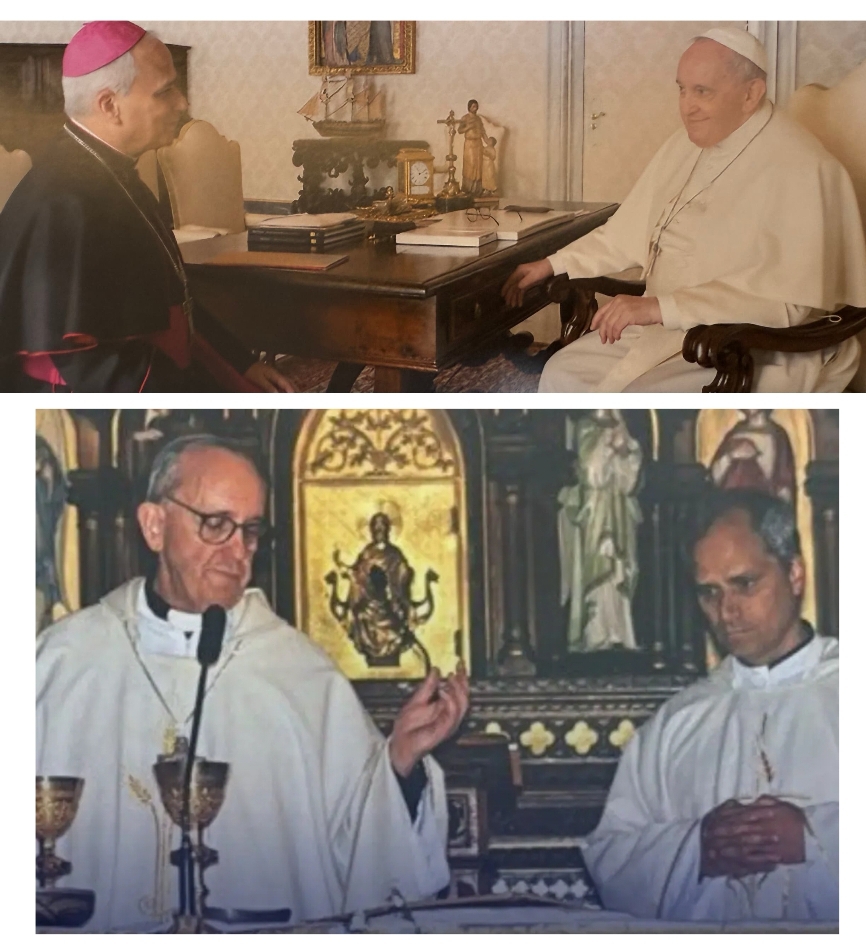
You do realise that from his grave in Santa Maria Maggiore, Pope Francis must be resting easy. To the very end, he was a man who, trusting in God and cooperating with God’s will, shrewdly initiated processes aimed at achieving the ends he had in mind. So, guess what? Who did he not only appoint bishop of Chiclayo in Peru but also bring to Rome barely two years ago to head the Vatican department for appointing bishops? Who did Pope Francis name just two months before his demise to the highest rank of cardinals, making him a Cardinal-Bishop, with the same rank as other cardinals considered his potential successors, such as Parolin and Tagle? Sure enough, Cardinal Robert Prevost, now Pope Leo XIV. Francis mentored Leo and must be smiling from the grave, as all leaders do when they have prepared others to take their place.
While he said this, our flight had landed smoothly in Kumasi, and the plane taxied to its stop. Placing my book away, I bowed to acknowledge each of my remarkable flight companions, posing myself the question, “When shall we three meet again?”
By Rev. Fr. Kpanie ADDY, SJ