

The cruel treatment meted out to widows and the seizure of properties in the name of customary and traditional rites by some tribes in Ghana has become a top issue that has led some Ghanaian Women, including Nuns, to champion advocacy against these rites and the treatment of widows through public awareness campaigns.
Despite the numerous calls by religious bodies and civil society organisations on Ghanaians to join forces to stop harmful widowhood rites and practices to preserve the human rights of women, the act is still in full force. According to the World Bank, one in ten African women above the age of 14 is widowed, and six percent are divorced, as many more have been widowed or divorced at some point in their lives.
Research has suggested that cultural perceptions that women do not need property meant that the law had not had the intended effects. The study observed that there is usually “significant social pressure from their families and communities not to seek formal legal recourse.”
The community expects a widow to prove her innocence through a series of obnoxious traditional rites and common practices like searching of the widow’s room two or three days after the demise of the man, cleansing rituals where the widow is asked to lie by the mortal remains of the late husband, drink the water used in bathing the body and even asked to bath the water, all in a bid to prove that the widow was not involved in her husband’s death and seizure of properties that pose a danger to their emotional health and general well-being.
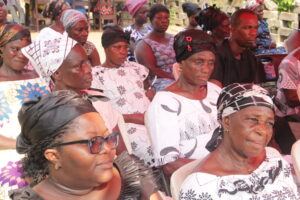
Some of these obnoxious practices are enforced by older women in the society who see themselves as custodians and champions of these dehumanizing practices. Widows are sometimes subjected to long periods of mourning lasting from a few months to about a year, which may compromise their ability to engage in meaningful economic activity that enables them to care for their children.
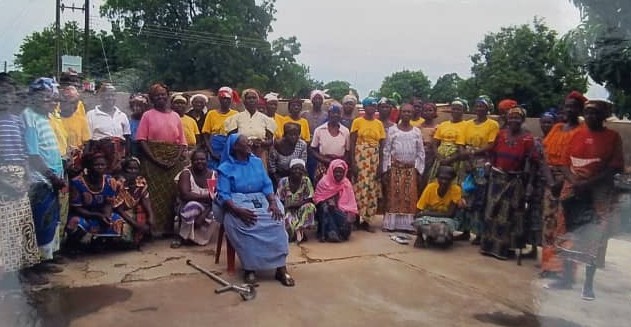
These practices led Sr. Gabriella Nounaah of the Congregation of the Sisters of Mary Immaculate (SMI) to establish the 40-year-old St. Monica Widows’ Association in a bid to bring women in the Nandom area in Ghana’s Wa Diocese together to educate them on how to live good lives and advocate for their rights.
“In 1985, I set a pace by calling all widows around the Nandom area for a meeting with the permission of the Parish Priest at the time. These widows first thought of material gifts from me, but they later understood that I was not giving them fish but intended to teach them how to fish,” she said.
“The number of widows who came out in the early days was overwhelming,” she said, adding, “I later divided them into groups, decentralizing the groups in various outstations within the now Basilica Parish of St. Andrew, other Parishes within the Wa Diocese, and later extended to other Dioceses of Ghana, with the majority in the Northern part of the Country”.
The current widows under the care of Sr. Gabriella are about 910 within the Wa Diocese, with forty-five groups, and the group also welcomes Muslim widows who are ready to follow the norms and rules of the Association.”
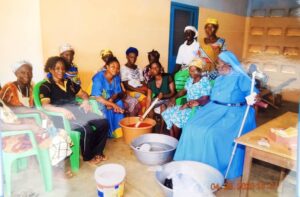
“Through this association, many of the widows have gained their dignity and the right to struggle on their own for a livelihood,” she said, adding, “The widows receive spiritual talks on the Catholic values of faithfulness to God through the Sacrament of the Eucharist, Catechism, and conversion, empowerment through self-reliance activities such as brewing “pito” (local Ghanaian northern drink), soap making, and petty trading,” she said.
She indicated that the outcome brought to the realization of the widows that their vulnerability lies in the fact that they are dependent on men, and so they took a stand to say no to any man who came to them for sexual pleasure, which usually leads to ill treatment.
A comparative study of widowhood rites among the Dagaaba and the Ewe people of Ghana recommends public awareness campaigns on the rights of widows as well as seminars, workshops, symposia, and media as tools to address the legal, religious, cultural, and socio-economic aspects that restrict widows and the community.
Ghana’s 1992 Constitution and the Matrimonial Causes Act of 1971 (Act 367) and the Intestate Succession Law of 1985 (PNDCL 111) are existing laws in Ghana meant to protect the rights of Widows.
The role of the National House of Chiefs in eliminating harmful practices against women and girls is rooted in Article 272 (c) of Ghana’s 1992 Constitution, which provides that the National House of Chiefs shall “Undertake an evaluation of traditional customs and usages to eliminate those customs and usages that are outmoded and socially harmful.”
Both the Constitution and international law give the National House of Chiefs the mandate to overturn cruel and inhuman traditions and ultimately to modify customs that are a clear breach of the realization of the human rights of women and girls.
57-year-old widow, Edith Vo-enga from Saapaari, Daffiama, and a member of Sr. Gabriella’s St. Monica Widows’ Association, told GSR, “We would have died or gone to the street had it not been for this association”.
“It has been seven years down the line since my husband died. Before the demise of my husband, our children were schooling, but after the death of their father, these children were withdrawn from school because no family member was ready to support them.
“When it comes to feeding, we are left to our fate depending on inconsistent ‘pito’ brewing, which is insufficient for a meaningful livelihood,” she said, pointing out, “This, for me, is the biggest problem, and I wish there could be assistance for my children’s education.
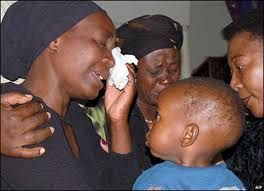
Angelina Dakuurah, 72, from Yibele, who couldn’t remember when exactly her husband died because it has been a long time, said, “since the death of my husband, leaving me with five children, the family ceased the portion of land that my husband was farming, meaning that there is no source of feeding for me and my children in the family, meanwhile the children have also stopped schooling”.
Asked how she survived with the children for this number of years, she said, “I used to do small pito business, but as I advanced in age, I became handicapped,” adding, “My main concern now is the portion of land to be returned to me for my son, who did not go to school, to farm for me.”
According to Sr. Gabriella, “I have engaged leaders at the various stations to assist the women and give a periodic report to the main station in Daffiama. I have also empowered some of my fellow SMI sisters to assist the widows at the various Dioceses and Parishes where they work”.
She narrated how a widow was sacked from her husband’s family simply because she refused to give in to marrying another man. “With this, I intervened by talking to the concerned family members, bringing to light the laws of the Catholic Church.
“I was able to bring this woman back to the house, though the family member declared no responsibility towards her well-being,” the 86-year-old Sr. Gaberialla stated, saying the association had been of great support to many of the widows.
“They have established a strong solidarity spiritually, materially, and with physical bonding. With little material support, they can stand and forge ahead in life challenges,” she said.
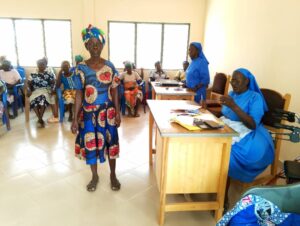
“On the feast of St. Monica, their patroness, they create joy intrinsically and encourage one another to remind each other to look up to God through the good people who come their way.
According to SMI Sr. Gaberialla, through appeals from benevolent people, the association has put up a small structure with little space, which is used for renting, and selected members also use a portion of it for brewing “pito” for the association.
“The widows are hardworking, relying on petty self-reliance projects, she said, noting, “They are very optimistic that God will hear their plight and come to their aid in assisting them with meaningful projects that can help uplift their desire for a better livelihood.
Sampling views of some Catholic women on this obnoxious and obsolete practice, Mary Mother of the Church Sr. Victorine Torkenoo, who once worked with widows said “The death of a man has become a period not just of mourning, but also a season for us widows to prove that we loved our spouses, we were faithful to them, and that we had no hand in their deaths, has become a worrisome activity for us.”
According to her, “Widows and widowers abound in every community we find ourselves. We find them in our Churches, in our communities, and even at our workplaces, saying that “My focus has been on the widows, for they are more vulnerable due to the dehumanizing treatments they are subjected to after the loss of their husbands,” she said.
“My apostolate has been teaching, and in the various schools I have worked, and encountered orphans. Their helpless conditions moved me with Compassion, and I asked questions which later took me to their homes. Frequent visitation is done by me to these homes as well as the homes of widows I meet in Church.
She added: “I prayed with them, encouraged them. They confined me as l won their trust. They see me as a ray of hope in their trying moments.”
She was of the view that encouraging some affluent personalities to assist them would go a long way to alleviate their state of destitution.
“While I am more into the spiritual aspect and counselling, which are very vital, as fear is injected into them by families of the deceased husband, eg, making them believe that the ghost of their husband could harm or kill them, I used to encourage some teachers on my staff whom I know could understand the situation, to help these helpless and vulnerable widows,” she indicated.
Adding, she said it is imperative to state that two of such vulnerable widows converted to Catholicism without compulsion.
On her part, in a message to mark the celebration of International Women’s Day in March 2025, Mary Mother of the Church Superior, Sr. Dr. Lucy Hometowu, lamented how widows face social stigma, discrimination, and violence, often blamed for causing their husbands’ deaths.”
An Obstetrician and Gynaecologist and Fellow of the Royal College of Obstetricians and Gynaecologists, she said that “These gender-based violence and violations of human rights undermine the health and well-being of young girls and women, the most vulnerable in society.”
“As women, we must rise and advocate for the eradication of these cultural and traditional practices that negatively affect the well-being of women so that girls and ensured that they are protected,” she advocated.
Across Africa, the impact of marital death and divorce falls more heavily on women, who may be excluded socially and lose their homes and property after a marriage ends. In much of Africa, marriage is the sole basis for women’s access to social and economic rights, and these are lost upon divorce or widowhood,” said the World Bank Report.

Dame Obapanin Gloria Kwasie, a widow who, though she did not experience any of such practices, is of the view that “Mourning a dead spouse is normal, but making a surviving spouse go through a period of emotional and physical discomfort must not be part of the mourning process.”
“It is unacceptable to deliberately add to the grief of widows in the name of tradition,” she added, emphasising that “Instead of enforcing such harmful practices, it will be more acceptable to enact and enforce laws that protect widows and safeguard their general health and well-being as they go through the challenging period of grief and mourning following the death of a husband.”
According to her, “Families and custodians of such unhelpful widowhood rites will also need to be sensitized and helped to understand that the law does not accept such harmful practices.”
“Advocacy groups and experts need to be encouraged and supported to come up with more acceptable and simple widowhood rites that do not infringe on the rights of any widow or widower,” Dame Kwasie said.
Sisters of the Word Incarnate Sr. Esther Kutie, an advocate for widows, said, “I strongly believe that with the level of formal education as a nation, some of our cultural practices, such as the so-called widowhood rites, should be expunged from our culture.”
According to her, education should improve the dignity of the human person, including widows. Our professors in Sociology and Anthropology need to do more research into these cultures to bring the evil in the cultures to light.
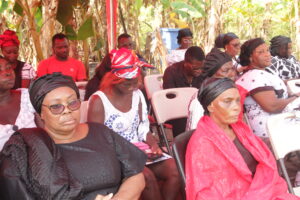
“I am aware that some institutions and organisations contribute to the poor during festive seasons. These donations go a long way to help the widows during those occasions, but what the widows need more is their liberation from the bondage of torture and humiliation,” she stated.
To her, “the Church is the strongest and loudest voice for widows, and in addition to what it is doing, I strongly recommend that a proper Widowhood Rite be formulated by the Ghana Catholic Bishops’ Conference, or at least, at the Provincial level, to be used by Dioceses and Archdioceses. This will help restore the dignity of widows in the Church and society at large.”
Sharing her experience, 68-year-old widow Augusta Aku, an Ewe married to an Nzema man from Ghana’s Western Region, said, “In just a few months after the death of my husband last year, October, I’m tired of these humiliations.”
“Two days after the death of my husband, the family travelled from their village to Accra to search our rooms without my initial consent. It was like an ambush search in the name of traditional customs,” she narrated.
Married for over 35 years, she said, “At the burial of my late husband in the Western Region of Ghana, I was asked to sleep by my late husband when the mortal remains were being prepared in the family house.”
“The discriminatory practices have inflicted pain on a grieving widow like me and make no sense in modern society,” she stated, adding, “We must understand that every practice that infringes on a widow’s rights or freedoms does nothing but add to the pain of her loss,” Augusta said.
According to her, “The harmful practices not only violate the dignity and freedom of widows, but they also have economic, health, and psychological implications.
Ghana has ratified many international charters and conventions that seek to promote an end to violence against women. Beyond this, it has put together its roadmap to steer programmes aimed at ensuring that women enjoy their fundamental human rights. This is evident in the passage of the Domestic Violence Bill into law by Parliament on February 21, 2007. This ushered in a new era and revitalized the hope of women and women’s advocacy groups in Ghana.
Though the rites have persisted, educating communities and empowering vulnerable women can help get rid of the practices. Ghanaians need to be empowered to understand the harm in the rites and empower them with the capabilities to resist such practices.
By Damian Avevor//Sr. Juliana Atuuna, SMI