
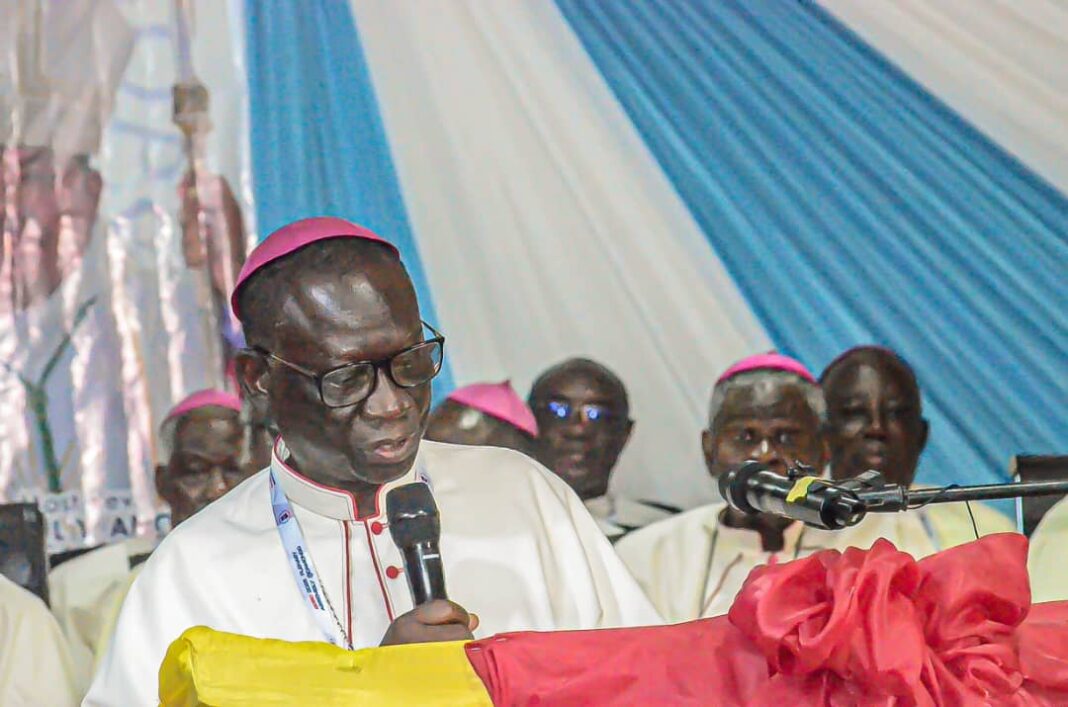

KEYNOTE ADDRESS BY MOST REV. MATTHEW KWASI GYAMFI, PRESIDENT OF THE GHANA CATHOLIC BISHOPS’ CONFERENCE (GCBC) AT THE OPENING CEREMONY OF THE 2025 PLENARY ASSEMBLY HELD IN THE CONFERENCE HALL, UNITY CENTRE, DAMONGO
ON MONDAY, NOVEMBER 10, 2025
THEME: A SYNODAL CHURCH AT THE SERVICE OF JUSTICE AND PEACE IN GHANA
- Introduction
Mr. Chairman, Dr. Gameli Kewuribe Hoedofia, Your Excellency Most Rev. Julien Kaboré, Apostolic Nuncio to the Republic of Ghana, Your Excellencies Archbishops and Bishops of the Conference, the Overlord of Gonja land, the Damongo Wura, The Regional Minister, Hon. Isifu Salisu Bi-Awurobe and entourage, Members of Parliament here present, MMDCEs, Clergy and Religious, Distinguished Invited Guests, Dear Lay Faithful, Friends from the Media. Ladies and Gentlemen, Brothers and Sisters in Christ.
It is with profound gratitude, hope, and pastoral joy that I address you at the official opening of this year’s November Plenary Assembly of the Ghana Catholic Bishops’ Conference.
At our last assembly in Obuasi 2024, we reflected on the theme “Jubilee Year: A Time to Proclaim Christ, Hope for the Church and Ghana” (cf. 1 Tim. 1:1). That reflection invited us to renew our faith in Christ as the living centre of the Church’s mission and the wellspring of authentic hope for our nation. We celebrated the Jubilee not as mere remembrance but as a call to conversion, reconciliation, and renewal. It was a moment to proclaim Christ as the one true hope who restores meaning, integrity, and direction to both the Church and the Ghanaian society. In line with last year’s theme, many activities have taken place in the course of the year to proclaim Christ, hope for the Church and Ghana, not least, the 75th anniversary of the establishment of the hierarchy of the Church in Ghana, with the elevation of Cape Coast as an Archdiocese and the creation of its then suffragans: Accra, Keta, Kumasi, and Tamale.
Building on that foundation, this year’s theme, “Synodality in the Service of Justice and Peace in Ghana,” will guide our reflection and deliberations. If the Jubilee called us to proclaim Christ as our hope, synodality challenges us to embody that hope together—to listen, to discern, and to act as one body animated by the Holy Spirit. It reminds us that the Church is not an institution that commands from above but a pilgrim people who walk together, translating faith into works of justice and peace within our national context.
- The Meaning of Synodality
Though the word synodality may sound modern, its essence is ancient and luminous. It expresses the Church’s vocation to journey with the People of God, listening to the Spirit who speaks through their experiences and discerning together the path of truth and renewal.
Synodality is not a bureaucratic process but a spiritual attitude. It prefers dialogue to decree, participation to isolation, and communion to control.
The Church, in her synodal life, is not a chorus of competing voices but a single symphony of faith harmonised in Christ. To be synodal is to be humble, attentive, and co-responsible—bearing one another’s burdens and sharing one another’s hopes. It calls us to walk together in solidarity, shaping a Church that listens before it speaks, and acts in the service of justice before it judges the world.
- In the Service of Justice and Peace
- The Socio-Political Landscape
Ghana continues to be admired as a beacon of democracy and peace in West Africa. Yet beneath this celebrated image lies a complex reality marked by inequality, corruption, and recurring violence that threaten the moral fibre of our society.
Politics and Electoral Tensions:
Since 1992, Ghana has conducted nine general elections and achieved four peaceful transfers of power—an enviable record of democratic stability. Yet the 2024 elections exposed deep fractures in our political culture. Independent observers described them as among the most violent since the beginning of the Fourth Republic. Police reports confirmed 106 arrests linked to post-election disturbances, several deaths, and numerous injuries. Democracy without conscience, however, is fragile; without truth and justice, it risks becoming ritual rather than renewal.
Environmental Degradation and Illegal Mining:
The scourge of galamsey continues to corrode both the land and the moral soul of our nation. As of 2023, over 60 percent of Ghana’s rivers and streams were polluted, thirty-four forest reserves compromised, and more than 4,700 hectares of forest destroyed. This devastation is not merely ecological—it is a moral and social tragedy.
The poor, especially women and children, bear the heaviest burdens of poisoned water, infertile lands, and lost livelihoods. Environmental destruction is a silent form of violence against the vulnerable and a sin against creation itself.
Chieftaincy and Communal Conflicts:
Persistent chieftaincy and ethnic conflicts continue to disturb the peace of several regions. The Bawku crisis remains among the most protracted and devastating, claiming between 200 and 300 lives since renewed hostilities in late 2021.
Schools, hospitals, and markets have repeatedly closed, paralysing social and economic life. Beyond Bawku, flashpoints such as Yendi, Bimbilla, Nkonya–Alavanyo, and Doba–Kandiga have experienced recurring violence. The humanitarian consequences are grave—internal displacements, broken families, and cross-border refugee inflows. Since 2022, more than 15,000 asylum seekers from Burkina Faso have entered northern Ghana, fleeing terrorist attacks in the Sahel. Our local communities, despite poverty, have shown heroic generosity with little external support. These realities remind us that peace cannot exist without justice, and security cannot endure without compassion.
- Synodality in Action – The GCBC’s Collaborative Witness
Election Monitoring and Civic Education:
Through its Directorate of Governance, Justice and Peace (DGJP) and diocesan commissions, the GCBC has remained a steadfast partner in safeguarding the integrity of our democracy.
During the 2024 elections, the Church collaborated with the Electoral Commission to recruit and train 500 observers deployed across 174 polling stations in 95 constituencies and 14 regions.
A central Election Situation Room, comprising experts from the Ministry of National Security, the UN Resident Coordinator’s Office, UNHCR, and civil society, ensured real-time monitoring and response. This collaboration exemplified synodality in practice—the Church walking with the nation in truth, vigilance, and civic responsibility.
Peacebuilding in Conflict Zones:
In areas marked by violence, the Church has served as a bridge of reconciliation. Under the Sahel Peace Initiative (SPI), the GCBC has partnered with the National Peace Council, regional authorities, and traditional leaders to mediate conflicts in Doba and Kandiga.
A joint mediation team, including chiefs from Ghana and Burkina Faso, helped restore calm and facilitate the return of displaced families. The Church’s pastoral accompaniment here is not theoretical advocacy; it is faith translated into healing action.
The Sahel Peace Initiative (SPI):
Born out of Catholic Relief Services’ Steps Toward Peace programme (2019), the SPI focuses on strengthening community resilience and social cohesion. In Ghana, it has supported over 1,000 asylum seekers from Burkina Faso through food, health, and educational assistance. In 2024, the GCBC and CRS convened the National Forum on Security, Social Cohesion, and Elections, drawing more than 200 participants daily, including government officials, journalists, and security professionals. On 15 July 2025, another SPI National Forum, co-organised with KAS and CRS, addressed youth unemployment and its link to social unrest.
The GCBC continues to collaborate with the National Peace Council and the National Centre for Early Warning and Response Mechanisms to develop a live conflict-mapping system for early intervention and preventive action.
Partnerships for Justice and Reconciliation:
In September 2024, the GCBC, through the Directorate of Governance Justice and Peace, co-hosted the Elmina International Conference on Dealing with the Aftermath of Slavery and the Slave Trade with the German Justice and Peace Commission. This historic gathering drew voices from Africa, the Americas, and Europe to examine historical injustices and discern pathways toward restorative justice and intercultural reconciliation. It was a global act of synodality—listening across continents to heal the wounds of memory and to build a just future together.
Environmental Justice and Care for Creation:
The GCBC continues to advocate for environmental justice through diocesan ecological desks, youth networks, and collaborations with the National Coalition Against Galamsey.
Through the Green Ghana Campaign and parish-based ecological actions, the Church calls all citizens to see creation not as property to exploit but as a sacred gift to protect. In the spirit of Laudato Si’, caring for creation is both a moral duty and an act of love for generations yet unborn.
- Conclusion
The Ghanaian Church’s journey of synodality, manifest in her pastoral outreach, advocacy, and partnerships, testifies to the transformative power of walking together.
Amid political tension, environmental decay, and social division, the Church continues to choose dialogue over division, collaboration over apathy, and moral leadership over indifference.
Yet our journey continues. Guided by our chosen theme, this year’s Plenary Assembly will deliberate, among other pressing national and ecclesial issues, the following:
- The future of Catholic education and its role in shaping minds and consciences;
- New and effective strategies for interinstitutional collaboration to combat illegal and irresponsible mining;
- Deeper Church engagement in mediating and resolving conflicts nationwide;
- The promotion of genuine religious tolerance, especially within our schools;
- Critical reflection on the proposed Hate Speech Bill and its implications for moral discourse and civic freedom; and
- The defence of the independence of the arms of government and state institutions, which is essential for truth, justice, and accountability in our democracy.
These are moral imperatives that test our witness as shepherds and citizens.
Synodality is a spirituality of communion that transforms hearts before it reforms systems. It teaches that peace is not merely the absence of war but the fruit of justice, and justice is love made visible. In the spirit of synodality, therefore, we invite you all to pray for us, your Bishops, as we begin these deliberations.
May God, the Lord of history and the Author of peace be present at our Plenary, bless our deliberations and, grant our Church and nation the grace to journey together – Bishops and Clergy, Consecrated persons and Laity, Citizens and Leaders – in truth, humility, and hope, that justice may roll down like waters and peace flow like a mighty stream across our beloved Ghana.
On this note, I have the honour and pleasure to declare the 2025 Plenary Assembly of the Ghana Catholic Bishops’ Conference duly opened. In the name of the Father, and of the Son and of the Holy Spirit.
I thank you for your kind attention.
MOST REV. MATTHEW KWASI GYAMFI
BISHOP OF SUNYANI & PRESIDENT OF THE
GHANA CATHOLIC BISHOPS’ CONFERENCE