

INTRODUCTION:
Growing up as a child, I must confess that I was very fond of Holy Thursday – the washing of feet and the dramatic re-enactment of the institution of the Holy Eucharist. I am sure that none of us child actors fully understood the depth of what we were portraying.
WHAT HAPPENS ON EVERY HOLY THURSDAY:
After Palm Sunday, also known as Passion Sunday, which opens for us Catholics, Holy Week, the next important day of great Liturgical importance of the Church is Holy Thursday, where we remember:
- The institution of the Holy Eucharist
- The institution of the ministerial priesthood
- The commandment of love expressed through service.
This took place on the night before Christ’s Passion, during the meal we now call the Last Supper.
- The Institution of the Holy Eucharist: This is the day on which Christ instituted the Holy Eucharist for the Church, the night before His betrayal, as a Memorial of His Suffering, Death, and Resurrection. This institution took place at a supper, and that was the last dinner/supper Christ had with His disciples, which is why we call it The Last Supper.
WHAT HAPPENED AT THE LAST SUPPER:
During the Last Supper, the Lord Jesus took bread, BLESSED IT, BROKE IT, and GAVE IT to His disciples to TAKE and EAT for THIS IS His BODY which would be given up for them and commanded them to break bread anytime they meet as a Church or Community of believers, anytime they meet IN MEMORY of Him.
Similarly, Christ, like any other Jew, had wine at every meal, just like the Italians, TOOK wine, BLESSED IT, GAVE THANKS, and GAVE it to His disciples to drink from as the Chalice of the NEW and EVERLASTING COVENANT, which would be poured out for the forgiveness of sins. DO THIS in MEMORY of ME.
THEOLOGICAL SIGNIFICANCE:
- Ordinary Elements, Divine Mystery: Christ used ordinary bread and wine, showing that God uses the ordinary to communicate extraordinary grace. Salvation is therefore not distant, but accessible. It is not far from our reach.
- Thanksgiving: (Eucharistia): Thanksgiving is central to Christian life. Christ gave thanks and said the blessings before the meal as we do at home, school, etc. This establishes that everything we have is from God and must be received with gratitude.
So whatever we lay our hands on, we must show deep gratitude for that provision.
- The Eucharist as the Centre of the Church: The Lord Jesus commanded the early Church (who were the disciples) to celebrate the Last Supper anytime they met as a Faith Community (Church).
It was never optional but compulsory: whenever the Church gathers, and time allows with pastoral favour, the Eucharist must be celebrated, as it forms the centre of our Christian Catholic life, spiritual food for our souls that strengthens, heals, and sanctifies, and accompanies us to our heavenly home.
(D) “Do This in Memory of Me”: The Lord insists that, anytime we celebrate the Eucharist/Mass, we do it IN MEMORY of Him.
In liturgical theology, memorial (anamnesis) does not mean mere remembrance. It means making present, rendering it ACTIVE and ALIVE as happening HERE and NOW (hic et nunc), the saving events of Christ.
This means that, anytime we celebrate Mass, that which Christ instituted many years ago, is seen as happening now by the SAME CHRIST (through His Priest who presides), who celebrates with us. Thus, every Mass is not a repetition, but a re-presentation of the one sacrifice of Christ, made present sacramentally.
Christ Himself acts through the ordained priest.
- The Institution of the Ministerial Priesthood: It is also understood as the day that Christ, the High Priest, instituted the Holy Orders/Sacred Priesthood for the Church.
Strictly speaking, no biblical text explicitly states that Christ instituted the Holy Orders. However, it is IMPLICIT: by instituting the Holy Eucharist at the Last Supper and GIVING the disciples AUTHORITY to repeat it in His memory, Christ effectively ordained them.
For one cannot be given a Faculty (Church power to exercise a particular ministry within a particular time and place) when he does not merit or qualify for that.
Thanks to James, who, in his text, by way of giving ancient Christian accounts of how the sick were anointed and prayed over, makes it clear that there existed priests when he says, “Is any among you sick? LET HIM CALL A PRIEST (some versions use ‘elders’), pray over him, and anoint him …” (James 5:14-16).
According to the Church’s teaching, the Priesthood is a gift and not a right or honour.
It is a duty of selfless service and not like a secular appointment or portfolio. It is by His mercies and unmerited love.
As one great theologian says, “The Eucharist makes the Church and the Church makes the Eucharist”.
From the Greek root of the word “Priest” (which is “presbiterios”), it means an old or aged person. The Italian word is “anziano” (old person) or “akɔkora” or “akora” in Asante Twi. This suggests maturity on the part of the Priest, to be a man of trust and faith, to be able to guard and teach prudently and courageously, the sound doctrines of the Church.
It is for this reason that the maturity and complexity of the work of a priest has the Canon law set twenty-five years as a mature age to be ordained as a Catholic Priest. There may be some exemptions in a few cases where the Diocesan Bishop or Superior needs permission from Rome when the candidate for Priestly Ordination is below the set age of Priestly Ordination.
- The Commandment of Love Expressed through Service:
The Lord Jesus gave us a Commandment of love and Service as He washed the feet of His disciples and asked them to do the same by serving one another. He says, “Love one another as I have loved you.”
This act of Christ teaches us humility, service, and
self-giving love.
Priesthood and Eucharist are inseparable from service.
A KEY TAKE-HOME – THE REAL PRESENCE (TRANSUBSTANTIATION):
At the Last Supper, Christ did not say “This represents my Body”, but “This is my Body…”, “This is my Blood.” After the Prayer of Consecration, therefore, the substance of bread becomes the Body of Christ, and the substance of wine becomes the Blood of Christ. This change is called Transubstantiation, a cross-over of physical substance to a Divine reality!
THE PRIEST AS ALTER CHRISTUS: The priest acts in persona Christi (in the person of Christ). By virtue of his Priestly Ordination, he is configured into the image of Christ, making him become ANOTHER CHRIST (ALTER CHRISTUS), not another Christ, that means a duplication of Christ, but a sacramental representation. At Mass, he takes the place of Christ, who truly celebrates the Holy Eucharist with the Church Himself.
It is Christ Himself who celebrates the Eucharist through the priest.
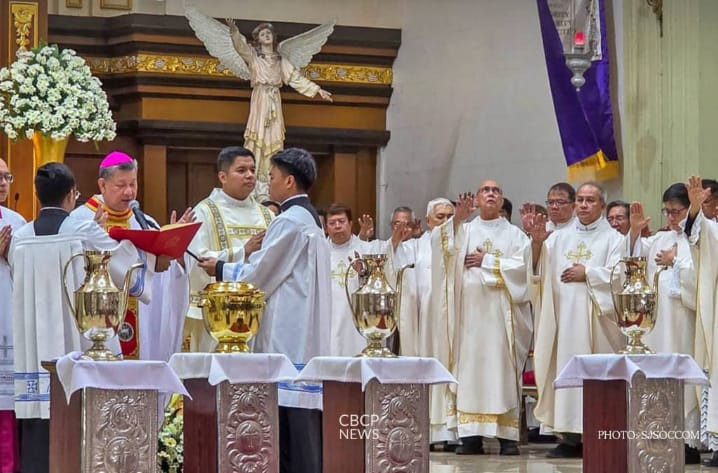
THE OTHER SIDE OF THE COIN: CHRISM MASS.
Normally, in the morning or afternoon of Holy Thursday, (if not shifted to Tuesday or any other day for a good pastoral reason to enable the Priests far away from the city, attend the Chrism Mass and have some time to return and prepare well for Mass of the Lord’s Supper on Holy Thursday evening), there is Chrism Mass at the Mother Church (Cathedral Church). During this Mass:
- The Priests working in the Diocese or Vicariate renew their Priestly promises (obedience and celibacy – not poverty for diocesan clergy) in communion with their diocesan Bishop or legitimate Superior.
- The diocesan Bishop, in union with his priests, receives and blesses the three Oils that would be used for administering the Sacraments.
- The Diocesan Bishop also invites his priests to pray for him to be a faithful Shepherd to exercise his Episcopal Ministry diligently and honourably.
THE SACRED OILS:
- Sacred Chrism (SC): Chrism means Christ (“kristos” in Greek). It is used for Baptism, Confirmation, Priestly Ordination, Episcopal Consecration to configure one into the image of Christ sacramentally, dedication of altars and churches. It signifies consecration and participation in Christ’s mission.
Again, it is used to consecrate the hands of a newly-ordained priest, rendering him worthy to transform bread and wine into the Body and Blood of Christ, respectively.
For Bishops, it is poured on their heads to have a full unction for discernment and to function as Chief Shepherd.
Catechumens also receive the SC as a mark of their common Priesthood, since after baptism, one becomes a Priest, a King, and a Prophet.
The other two Oils, apart from the SC, are blessed, but that of the SC is consecrated only after it has been mixed with a special oil called Balsam, which gives the SC a very nice fragrance (of holiness).
At Chrism Mass, the Bishop breathes upon the SC that the Spirit of the Lord may descend upon the SC.
- Oil of Catechumens (OC): It is used before Baptism to initiate a person into the Christian faith. It is equally used to strengthen the faithful against the power of sin and evil and to prepare them to live faithfully as followers of Christ.
(C) Oil of Infirmary (OI)/Oil of the Sick (OS): As you and I may know, it is used in the anointing of the sick to give grace, strength, comfort, and Divine Healing. It also unites their sufferings with Christ.
This Oil is equally used to anoint communicants who need to undergo surgery.
Important correction: It is important to correct here that the Oil of the Sick is not specifically for surgery, but for serious illness or weakness due to age.
It is interesting to know that this Sacrament ideally includes Confession, the Reception of the Holy Eucharist (Viaticum if near death), and finally the Anointing (of the sick) itself.
PROCESSION WITH THE NEW OILS:
In some parts of Italy, to help the laity recognise that fresh Oils have been received from the Chrism Mass through the diocesan bishop, the new Oils in their Jars are well placed on a tray and adorned with flowers during the Mass of the Last Supper on Holy Thursday evening. They are carried in the procession for the Mass and placed on the altar, or another appropriate place, and an announcement is made to create awareness.
WHERE TO KEEP THE OILS:
Though the blessed Oils are not as sacred as the Holy Eucharist, it is appropriate to keep them in a dignified place. In some Churches, they are kept in the old tabernacle in the Sacristy. Others, too, in an appropriate place in the Sacristy or the Mission House Chapel.
CONCLUSION:
As Catholics, we are called to love and support our priests and bishops, and, most importantly, pray constantly for them, for they are human instruments chosen for a divine calling out of the crowd (Heb 5:1), and sanctified to offer sacrifices for their own sins and those of God’s people.
I’m very confident that with this understanding, henceforth, whenever we see the abbreviations on the oil jars, we will recognise the names of the oils and what they stand for, and can appreciate more deeply their meaning and importance in the life of the Church.
By: Rev. Fr. Albert Kyei Danso
Chaplain,
Holy Family Ghanaian Catholic Community,
Italy.