
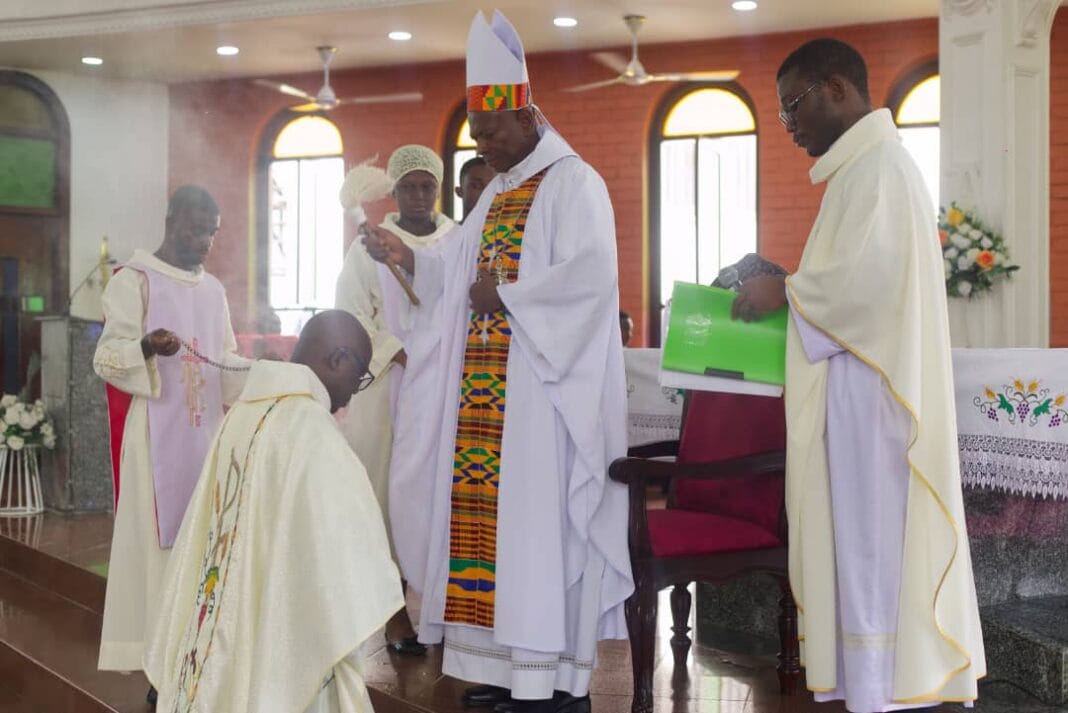

In an answer to a question on his Whatsapp platform: “Ask Bishop Bonsu”, the Emeritus Bishop of Konongo-Mampong Diocese, the Most Rev. Joseph Osei-Bonsu Bonsu, has given an extensive education on the processes of selecting a priest to be appointed as Parish Priest.
Below is the question posed by Damian Dieu Donne Avevor and answered by Bishop Osei-Bonsu.
_Questions by Damian Dieu Donne Avevor, Accra Archdiocese:_
My Lord, I respectfully seek your education and guidance on the following matters concerning the appointment and installation of a Parish Priest: What is the distinction between a Priest-in-charge, a Parish Priest, a Parochial Administrator and a Rector? What is the process for selecting a priest to be appointed as Parish Priest? Who qualifies to be appointed Parish Priest, and are there specific requirements that must be fulfilled before such an appointment can be made? Are there also particular requirements or procedures for the canonical installation of an appointed Parish Priest? Is there a prescribed period within which a Parish Priest must be canonically installed following his appointment? What should be taken into consideration when planning the canonical installation of a Parish Priest? Finally, when a parish has been canonically erected, is it automatic that a priest serving in or assigned to that parish becomes its Parish Priest, or is a separate canonical appointment by the diocesan bishop required?
_Answers by Most Rev. Joseph Osei-Bonsu:_
Dear Damian, your inquiry reflects a genuine interest in the Church’s structures of governance. It is a fair question, because titles like these are often used loosely in parish life, though canonically they are not interchangeable. The governing norms are found in the 1983 Code of Canon Law (CIC), especially canons 515–552 (parishes, pastors, and parochial vicars) and canons 556–563 (rectors of churches).
In brief: a Parish Priest is the proper pastor of a parish, holding stable canonical responsibility. A Parochial Administrator governs a parish temporarily, when the office is vacant or impeded. A Parochial Vicar assists the Parish Priest. Priest-in-charge is generally a local or particular-law term for a priest given pastoral responsibility without necessarily holding canonical pastor status. A Rector ordinarily governs a church or institution that is not a parish, unless particular law provides otherwise. Below I address the eight questions in turn, grounded in universal law and applied to the practice of a typical diocese.
1. The Basic Distinctions
The Parish Priest or Pastor is entrusted with the pastoral care of a canonically erected parish as its proper pastor, under the diocesan Bishop’s authority. Canon 519 describes him as responsible for teaching, sanctifying, and governing the community entrusted to him — not merely the priest who happens to celebrate Mass there, but the holder of a stable office with full cura animarum (“care of souls”). He is appointed for an indefinite period unless the Episcopal Conference has decreed otherwise (c. 522), by episcopal decree, with full canonical authority. In a particular diocese, for various pastoral and other reasons, they may be appointed for a definite number of years, for example, six years. This may or may not be renewable, depending on the diocese.
The Priest-in-charge is not a technical office under the universal Code. It is a designation used in diocesan practice for a priest placed over a community, station, rectorate, quasi-parish, chaplaincy, or mission station that has not yet attained full parish status, or occasionally over a parish for a specific, limited purpose. His exact canonical standing depends on the terms of his decree of appointment and on particular law, and one should not assume that every Priest-in-charge is a Parish Priest in the canonical sense: the role is typically temporary, without the stability proper to pastoral office.
The Parochial Administrator is appointed to govern a parish temporarily when it becomes vacant — through the transfer, retirement, incapacity, or death of the Parish Priest — or when the Parish Priest is impeded by illness, exile, imprisonment, or similar cause. Canon 539 requires the Bishop to appoint an Administrator as soon as possible in such cases, and under canon 540 §1 he generally holds the same rights and duties as a Parish Priest unless the Bishop determines otherwise, though he must avoid anything that could prejudice the rights of the Parish Priest or damage parish goods. Major long-term decisions are restricted during his tenure, and he must render an account when his administration ends (c. 540 §2). He is, in short, a caretaker shepherd, maintaining spiritual and administrative stability until a permanent Parish Priest is installed, and he may in time be confirmed in that office himself.
The Parochial Vicar is a priest who assists the Parish Priest under his authority — a co-worker, as canon 545 puts it, not the principal pastor. He shares in pastoral ministry but does not hold the office of Parish Priest, and he should not be confused with the Parochial Administrator: the Administrator temporarily replaces the Parish Priest in governance, while the Vicar collaborates under an existing Parish Priest.
The Rector of a church is entrusted, per canon 556, with the care of a church that is not a parish church, a capitular church, or one attached to a religious community or society of apostolic life. His responsibility is to a church, or to a rectorate or quasi-parish territory, rather than to a parish community as such, and he has no cura animarum (“care of souls”) over a people unless the Bishop grants it. He may celebrate liturgical services there, but this does not confer the rights of a Parish Priest; canon 558 in particular restricts him from performing distinctly parochial functions, such as baptism, marriage, or funeral rites, without the Parish Priest’s consent or delegation.
2. Selecting a Priest for Appointment as Parish Priest
The appointment of a parish priest belongs to the diocesan Bishop, ordinarily by free conferral (c. 523), except in the rare case of a legitimate right of presentation or election, which is uncommon in Ghana’s dioceses. In practice, the Bishop and his Personnel Board – usually the College of Consultors – first assess parish vacancies and pastoral needs across the diocese, whether in the cities like Accra, Kumasi, and Cape Coast, or in the more rural mission stations of the north and other outlying areas. Under canon 524, the Bishop then weighs suitability, avoiding favouritism or tribal and ethnic bias, and hears the Vicar Forane (Dean) of the deanery, while also consulting, as appropriate, certain priests and lay members of the faithful, such as members of the Parish Pastoral Council or Parish Laity Council. He considers all fit priests, not only those who put themselves forward, taking into account the diocese’s mix of diocesan clergy and, where relevant, priests from religious congregations working within its territory. He discerns among candidates on the basis of pastoral experience, spirituality, fluency in the local language(s) of the community, and fitness for the particular parish, whether that parish is a well-established urban congregation or a growing mission area. The process concludes with a formal decree of appointment, often announced to the parish community and read out during Sunday Mass, specifying tenure and duties. In most Ghanaian dioceses, this means the Bishop consults the Presbyteral Council, the relevant Vicar Forane, the Chancellor, and, discreetly, certain lay leaders of the vacant parish, such as catechists and heads of the Pastoral or Parish Councils. There is no lay election, notwithstanding the strong sense of communal ownership many Ghanaian parishioners feel towards their local church. This is an act of governance, not a democratic process, and the canonical responsibility rests with the diocesan Bishop alone.
3. Who Qualifies to Be Appointed Parish Priest
Canon 521 sets the standard. The candidate must be a validly ordained priest, outstanding in sound doctrine, integrity of character, zeal for souls, and other pastoral virtues (c. 521 §2), and he must possess whatever qualities universal or particular law requires for that specific parish, such as language, experience, or health. He must show genuine commitment to pastoral care and community service, with relevant pastoral experience, and his suitability must be established with certainty, by a method the diocesan Bishop determines, which may include examination (c. 521 §3). Ordination alone, then, does not qualify a priest for this office; he must be judged suitable for the particular pastoral charge.
4. Requirements for Appointment
Several requirements govern the appointment. There must be clear suitability, established with certainty for the specific parish rather than mere general availability, and the office itself must be vacant or formally opened. The candidate must be free from canonical irregularities or impediments to ministry, and his appointment requires approval from the relevant ecclesiastical authority. Stability is the norm: appointment is ordinarily for an indefinite term (c. 522), and fixed terms require Episcopal Conference authorisation; some national Bishops’ Conferences permit definite terms in practice, though the underlying canonical norm remains stability. A written decree of appointment is required (c. 156), detailing tenure and duties. Where the pastor is to be a religious, canon 520 requires that a specific priest be named and that a written agreement exist between the Bishop and the competent Superior, since a religious institute as such cannot hold the office itself. Diocesan norms on experience, formation, administrative competence, and pastoral skill may also apply, arising from particular law, and a stable spiritual life consonant with Church teaching is expected throughout.
5. Requirements for Installation
Appointment and taking canonical possession are distinct acts. Canon 527 §2 provides that the local Ordinary, or a priest he delegates, places the Parish Priest in possession according to particular law or legitimate custom, with dispensation possible for just cause. This requires the formal decree of appointment, the Profession of Faith and Oath of Fidelity (c. 833, 6°), the act of installation itself performed by the Bishop or his delegate, and the taking of canonical possession, from which moment the pastoral care, and its obligations, formally begins. Installation is thus not merely ceremonial; it carries genuine canonical weight. In practice it typically includes presentation of the decree, the profession of faith and oath, symbolic gestures such as the handing over of keys, occupying the presider’s chair, and opening the tabernacle, celebration of the Eucharist, and formal recognition by the community, though the precise ritual depends on diocesan norms and legitimate local custom.
6. Time Between Appointment and Installation
The universal Code sets no fixed interval. Canon 527 §3 leaves the local Ordinary to prescribe the period within which possession must be taken, and if the priest fails to do so without just impediment, the Bishop may declare the parish vacant. Many dioceses allow roughly thirty to sixty days, and each diocese has its own norm, best confirmed with the local Chancery. Absent a specific timeframe, custom generally calls for installation within a few weeks to a couple of months of the appointment’s effective date, and a legitimately impeded priest may be granted an extension. The key canonical point is that pastoral care does not begin merely because an appointment has been announced (c. 527 §1); it begins with possession.
7. Planning an Installation
Good planning attends to both the canonical and the pastoral dimensions of the event. On the documentary side, this includes the decree of appointment, the Profession of Faith and Oath of Fidelity, the handover of the seal, keys, and registers of baptism, marriage, and death, an inventory of goods per canon 1283, a financial report from the outgoing pastor or administrator, and an Installation Protocol signed by the Dean, the new Parish Priest, and witnesses. Liturgically, the installation normally takes place within Mass, presided by the Bishop or his delegate, following diocesan norms and approved liturgical books, and including the rite of handing over keys and access to the font, confessional, and tabernacle.
This requires coordination with the diocese to secure the Bishop’s or his delegate’s presence, and coordination with the parish itself, including the Parochial and Finance Councils, choirs, and liturgical ministers, along with informing the community and neighbouring clergy. The occasion also calls for the formal presentation of the new Parish Priest to the parish and clergy, and his introduction to the Parochial and Finance Councils, staff, and principal parish groups (cc. 536–537). The purpose of these symbols is genuinely pastoral and canonical, not merely ceremonial: a Parish Priest is being entrusted with a community of God’s people, not appointed manager of parish property.
8. Is It Automatic Once a Parish Is Canonically Erected?
No, and this deserves particular emphasis. Erecting a parish and appointing its Parish Priest are two separate juridic acts. Canon 515 defines a parish as a stable community entrusted to a pastor under the Bishop’s authority, and only the Bishop may erect, suppress, or alter parishes, after hearing the Presbyteral Council (c. 515 §2). Elevating a station, quasi-parish, or mission to full parish status does not, by itself, make its existing Priest-in-charge its Parish Priest. Even where the Bishop retains the same priest who built up that community, often the right pastoral choice, he must still issue a distinct decree naming him Parish Priest, and the priest must formally take canonical possession. No priest becomes pastor by seniority, by years of service as vicar, chaplain, or rector, or by having served as Priest-in-charge. He becomes Parish Priest only by satisfying canon 521, being freely and deliberately chosen per canon 524, receiving conferral under canon 523, and taking possession under canon 527. Canon 526 §2 further provides that there can be only one pastor per parish, and any contrary custom is not permitted.
For further explanations or enquiries, you may contact the author, Most Rev. Joseph Osei-Bonsu, Emeritus Catholic Bishop of Konongo-Mampong, on this number: 0244488904, or on WhatsApp (with the same number).