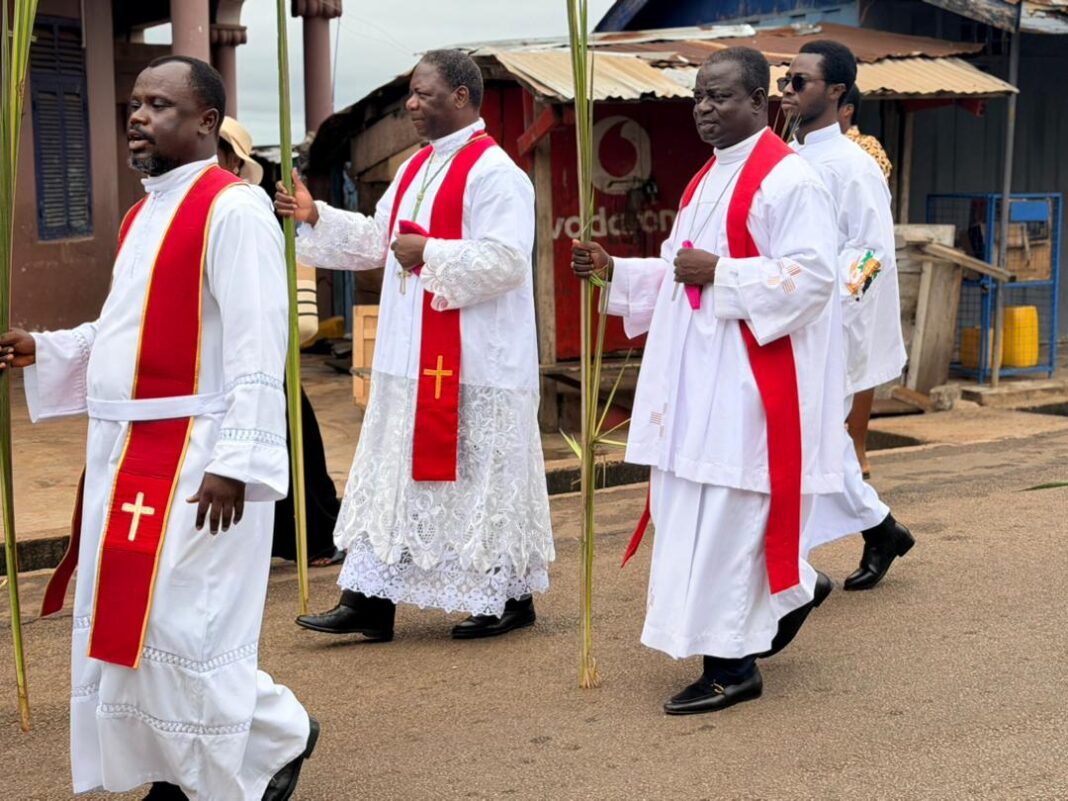

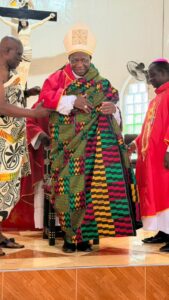
His Excellency Most Rev. Julien Kabore, Apostolic Nuncio to Ghana, joined the people of God of the Our Lady of Annunciation Cathedral at Sefwi Wiawso in the Western North Region of Ghana to celebrate this year’s Palm Sunday, with an invitation to them to see the Cross as the great yes of God to humanity.
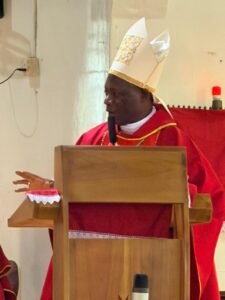
“Palm Sunday invites us to a deeper understanding: the Cross is the great ‘Yes’ of God to humanity. It is the true tree of life. For life is not found in grasping or possessing, but in offering oneself in love. It is in the gift of self that life reaches its fullness. The Cross, therefore, is not the negation of life, but its highest expression,” he said in a homily on Sunday, March 29, 2026.
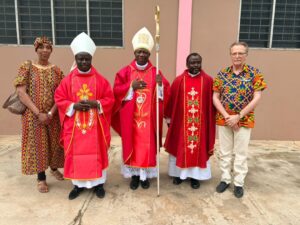
Concelebrating the Mass with the Nuncio was the Most Rev. Samuel Nkuah-Boateng, Bishop of the Catholic Diocese of Wiawso, and Very Rev. Fr. Eric Kusi Appau, the Cathedral Administrator.
The Nuncio was in the Diocese for a three-day visit during which he presided over the Mass on Saturday, March 28, 2026, to climax the 25th Anniversary of the inauguration of the Diocese.
In his rich homily at the Palm Sunday Mass, the Papal Representative also called on them to see Christ as the King of Poverty, Peace, and universality, saying that “At the threshold of this sacred celebration, three luminous paths open before us, shaping our contemplation and our response: poverty, peace, and universality.”
He noted that “In these, the mystery of Christ the King is revealed, and through them, we are invited to enter more deeply into His Paschal way.”
According to the Nuncio, “On this day, as we acclaim the Lord who comes, may we be granted the grace to follow Him not only with our voices, but with our lives- walking in humility, in trust, and in that freedom of heart which opens the way to peace. Inner freedom is the indispensable condition for overcoming the corruption and greed that wound our world.”
Dilating on the three luminous paths, Archbishop Kabore said Christ the King “is poor, poor among the poor and for the poor, not merely in outward condition, but in the deeper sense of those whose hearts are free, who trust in God, and who live in quiet openness to His will.”
“For it is possible to lack material goods and yet remain inwardly bound by the desire for possession or power. Such attachments harden the heart and obscure the vision of God,” he stated.
The poverty of Christ, the Papal Representative noted, “is above all an interior disposition: a freedom from the grasping spirit, a heart purified and made capable of recognizing all things as gift and responsibility.”
“It is a poverty that places us under the gaze of God, teaching us to receive, to share, and to walk in trust. It is the path of Him who, though rich, became poor for our sake, so that we might learn the true wealth of a life given in love,” he preached.
Touching on Christ as the King of Peace, the Apostolic Nuncio said the prophet revealed that Christ causes the instruments of war to disappear, He breaks the bow and proclaims peace to the nations.
“In Jesus, this promise finds its fulfilment in the mystery of the Cross. The Cross becomes, in a profound sense, the broken bow-God’s new sign of
reconciliation, spanning heaven and earth, healing divisions, and restoring communion. It is the humble yet powerful sign of a love stronger than death,” he told the large congregation.
He reminded the people of God of the words of a Bishop who, in the face of violence and fear, urged his people not to respond with retaliation, but to hold fast to the Gospel. Raising his rosary, he said, “Our weapon is this.”
The Nuncio stated that “In truth, the Cross, though fashioned from the same wood as instruments of harm, is transformed into an instrument of peace,” adding that “Each time we trace its sign upon ourselves, we are reminded that evil is not overcome by evil, nor violence by violence, but by the quiet strength of goodness, forgiveness, and love.
On Christ as the King of universality, Archbishop Kabore said, “The prophet opens before us a horizon that extends from sea to sea … to the ends of the earth.” No longer confined to a single land, this kingdom embraces all peoples and all nations.”
According to him, “It is a kingdom without borders, where diversity is not erased but gathered into unity. In the fullness of time, this vision takes shape in the communion born of Christ-above all in the Eucharist, where, across the world, communities are united as one Body. From every place and culture, the faithful are drawn together into a single people, reconciled and renewed, forming a living network of peace that stretches to the ends of the earth.”
He indicated that “He comes to meet every person and every culture. He is present in the simplicity of humble dwellings and in the hidden life of rural communities, just as He is in the solemn beauty of our cathedrals.”
Adding, the Nuncio said, “Everywhere, He remains the same, One and Lord of all, and those who gather around Him in prayer are drawn into one body, one communion. He reigns not by domination, but by self-gift: He makes Himself our He gives Himself to us. In this way, quietly and truly, He builds His Kingdom.”
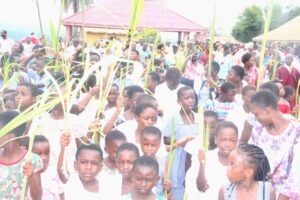
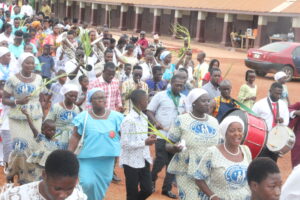
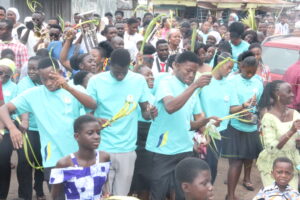
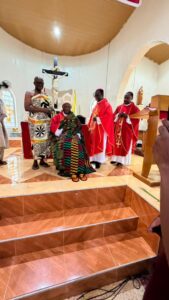
Before the Mass, the Nuncio was accompanied by Bishop Nkuah-Boateng and the faithful for the Palm Sunday procession through Wiawso town despite the rain. With a brass band, the faithful, both old and young, danced, raising their palm fronds, singing “Hosanna.”
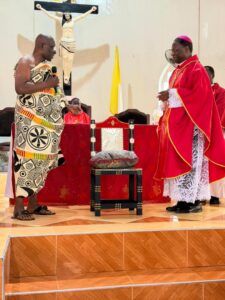
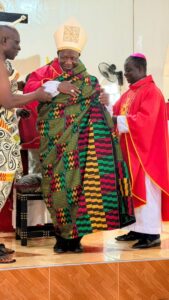
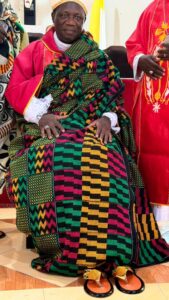
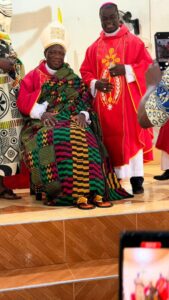
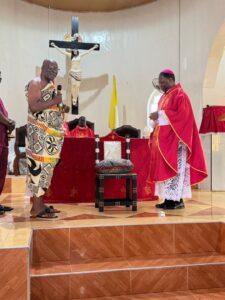
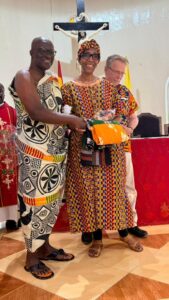
After the Mass, the Cathedral Community made presentations to the Nuncio to thank him for joining in the Palm/Passion Sunday Mass.
By Damian Avevor (Wiawso Diocese)