
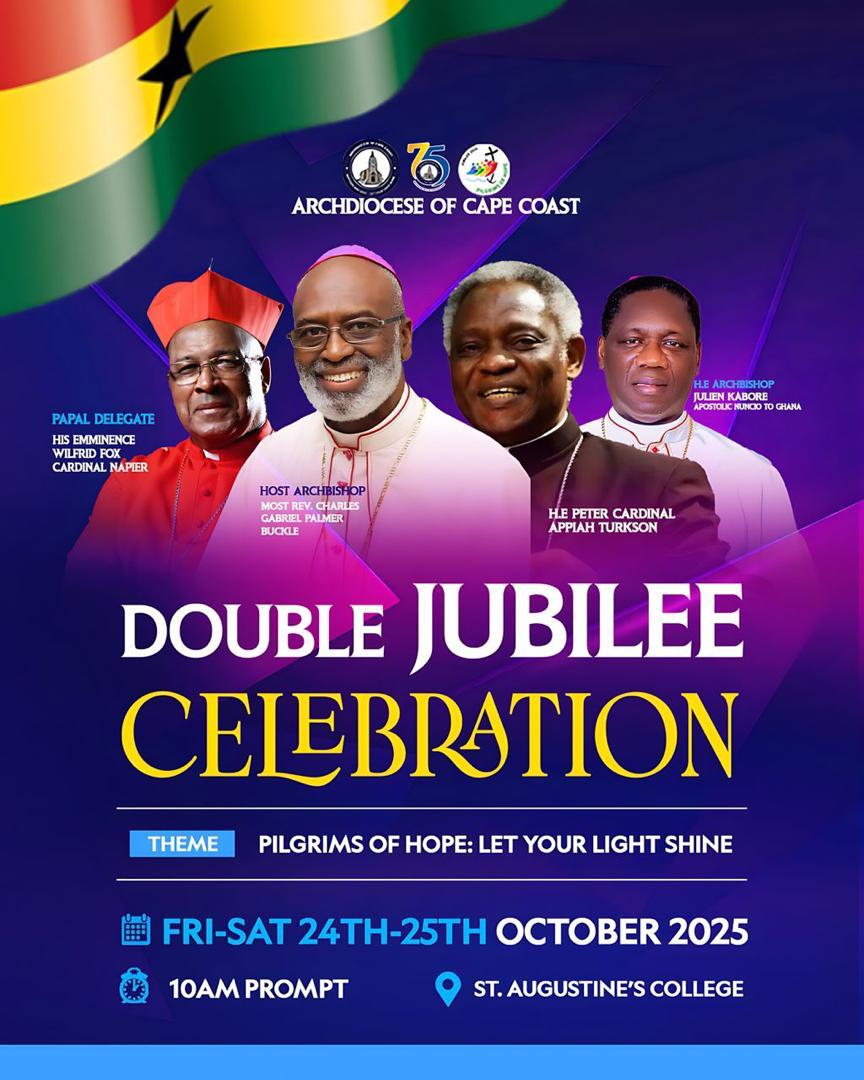

In a mere couple of days, specifically on Saturday, October 25, 2025, the climax of the diamond jubilee celebration of the establishment of Ghana’s Catholic hierarchy will take place in Cape Coast. The decision by the Holy Father to delegate an envoy, Cardinal Wilfred Fox Napier, OFM, Emeritus Archbishop of Durban, to preside at the solemn concluding Eucharist underscores the significance of a celebration that some, including this writer, argued should have taken on a broader national character than it has done. Credit goes to the Catholic Archdiocese of Cape Coast for spearheading this celebration, whose import bears on the entire Catholic Church in Ghana. The Pope’s letter to Cardinal Napier evinces the extensive scope of the anniversary, as it recalls “the 75th Anniversary of the creation of the Archdiocese of Cape Coast and the Dioceses of Accra, Keta, Kumasi and Tamale”.
In effect, all Ghana’s current local Churches, comprising four Archdioceses, fifteen Dioceses, and one Apostolic Vicariate, trace their origins to the auspicious establishing document issued on April 18, 1950. Historically speaking, on that date, the Apostolic Vicariate of the Gold Coast (in Latin, A Litore Aureo, hence not even Cape Coast) was elevated to become an Ecclesiastical Province, from which subsequently emerged three more ecclesiastical provinces – Tamale, Accra, and Kumasi – in chronological order.
In 2030, another mere five years from now, the Catholic Church in Ghana will mark a far greater milestone. It was on Tuesday, May 18, 1880, that the SMA Fathers, August Moreau and Eugene Murat aboard the British warship Dwarf berthed at Elmina to begin Catholic re-evangelisation of the Gold Coast. By remarkable coincidence, the locus of Catholicism’s return to our nation’s shores lies in the Catholic Archdiocese of Cape Coast. It will be interesting to see if Ghana’s Catholic Church leadership will mobilise its members for a more collective and nationwide anniversary celebration than has characterised the present diamond jubilee. Indeed, it was with this momentous anniversary in mind that this writer proposed that the celebration of the hierarchy’s 75th anniversary serve as a launchpad for planning the 150th birthday of contemporary Ghanaian Catholicism. Saturday’s celebration at St Augustine’s College rekindles the urgency of this plea for the Catholic Church in Ghana whose ceaseless refrain includes plaintive chants about its steadily dwindling population.
It is not too late for Ghana’s Catholic leadership to ride the crest of Saturday’s climax liturgy and put out into the deep towards a fruitful and impactful 150th anniversary of an uninterrupted Catholic mission. Fortunately, barely a week after the Cape Coast event, the Ghana Catholic Bishops’ Conference (GCBC) is scheduled to hold its Annual Plenary Assembly in Damongo. A simple statement outlining a tentative ecclesial vision for 2030 and broad proposals towards achieving that vision in the next five years would be laudable as an outcome of the GCBC’s Damongo meeting. This first step by our Bishops of articulating their hopes for the Church in Ghana, could be used to elicit initial interest and invite views from across the spectrum of Catholics in Ghana: Catechists, Young Adults, Religious Sisters and Brothers, Professionals and Intellectuals, Seminarians, Pious Groups and Friendly Societies, Students, Priests, etc.
Creativity and innovation will drive this process of eliciting interest and inviting wide-ranging views. The modus operandi would necessarily be audience specific and could include such forms as themed workshops, fora and town hall meetings for groups like Catholic professionals and intellectuals, seminarians and catechists. Religious congregations, pious associations, friendly societies and NUGCDPA (National Union of Ghana Catholic Diocesan Priests Associations) could organise their annual assemblies, chapters and congresses to discuss the theme of Ghanaian Catholicism’s 2030 ecclesial vision and its implementation. The reflections of the youthful members of the Ghana’s Catholic population could be teased out through something along the lines of deanery, diocesan, and possibly a nationwide essay writing competition on a topic centred around the ecclesial vision for 2030, thus shoring up enthusiastic participation.
Carefully considered, the process described above is nothing short of synodal – walking together – our way of being church today. Synodality flies in the face of clericalism and episcopalism, the latter phenomenon being what frequently characterises present-day Ghanaian Catholicism. Episcopalism – this writer’s term – describes an overstated focus on the figure of the bishop, who is, admittedly, the embodiment of unity and charity in the ecclesial assembly. Yet, episcopalism and its corollary of clericalism, evident in such symbols as our church flyers and banners is lamentable since it is counterproductive; invariably very little is achieved without the bishop’s imprimatur, usually expressed by his actual, physical presence. For ultimately, the bishop is only one person among many, including even the priestly body, his closest collaborators. The ordinary conditions of life such as time, space, an individual’s physical and mental capacity limit the most well-intentioned of bishops, like every other human leader. Thus, while pastoral efficiency relies on processes like effective delegation, collective ownership of and participation in an ecclesial vision requires synodality.
Our present-day overemphasis on the bishop in Ghanaian Catholicism is not only theologically outdated (ubi episcopus, ibi ecclesia – where the bishop is, there is the church) but also pastorally inefficient. Its consequence are local Churches whose administrations are male-dominated, top-down, and tone-deaf. In their place, an ecclesial vision for 2030 should envisage local Churches that realise a healthier gender balance vis-a-vis non-sacramental leadership positions, broader stakeholder engagement and inclusion of minority views, and deeper, authentic listening. While we may never abandon the principle of Roma locuta, it is necessary that authoritative decisions are preceded by and proceed from a place of objective, heartfelt, sincere listening to the local Church’s cross-section of all the baptised, the least as well as the greatest; thus, antequam loqui, Roma audit. Through conversion of our hearts, episcopalism and clericalism, aspects of the bane of present-day Ghanaian Catholicism, must steadily cede to the blessing of synodality.
Damongo represents a kairos and watershed for the GCBC, taking place as it is on the heels of a seemingly hesitantly organised 75th anniversary of that institution’s establishment. Judging by their attainment of retirement age, some of Ghana’s long-serving bishops, including two metropolitans, may be participating in their last plenary as actively serving Prelates. This article concludes by proposing that rather than go out with a whimper, these doyens of present-day Ghanaian Catholicism exit active service of the episcopal conference with guns blazing, achieving this by contributing to shape the collective aspirations of a teleological and theological vision for the Catholic Church in Ghana. Damongo’s articulation of such a vision and five-year plan of action will serve to position Ghana’s Catholics for the giant leap forward.
By Rev. Fr. Kpanie Addy, S.J.