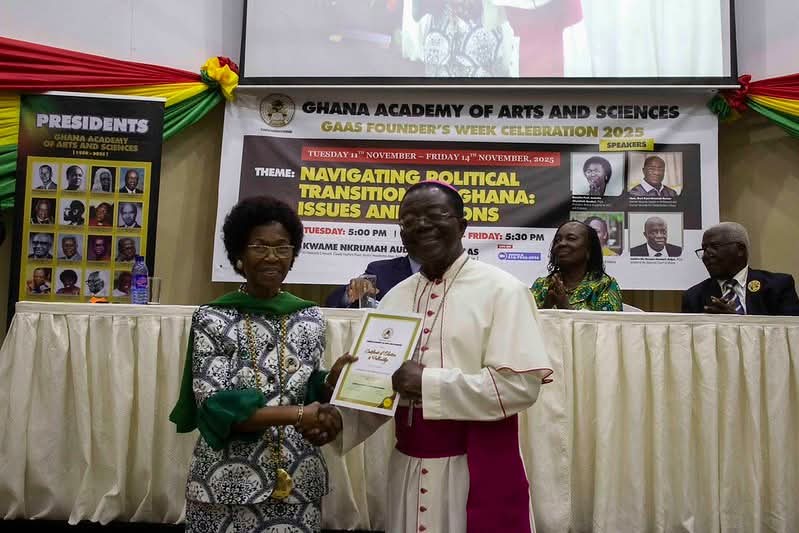

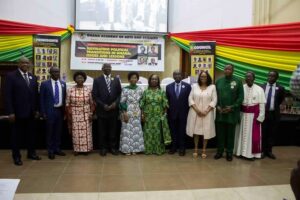
On Tuesday, November 11, 2025, while the attention of most Catholic media focused on Damongo, covering the Ghana Catholic Bishops’ Conference (GCBC) plenary assembly in the Savannah regional capital, an important event for the church took place at the Ghana Academy of Arts and Sciences auditorium in Accra. Most Reverend Joseph Osei-Bonsu, Emeritus Bishop of the Catholic Diocese of Konongo-Mampong, was inducted as a fellow into the Ghana Academy of Arts and Sciences (GAAS), alongside five others. This momentous occasion, which Bishop Osei Bonsu reportedly described as the highest professional destination in their careers, is a source of pride and inspiration for the entire Catholic Church in Ghana.
The reputation of the GAAS, founded in 1959 on the initiative of the country’s first president, Dr Kwame Nkrumah, confirms Bishop Osei Bonsu’s remarks. Worldwide, it is no mean feat to face peer-review scrutiny and emerge worthy of membership into a nation’s highest body of scholars. For those who know Bishop Osei-Bonsu, particularly some teachers from his formative years, such as Fr. Gerard Bles, SMA, and Archbishop Emeritus Peter Sarpong, his achievements will come as no surprise. Both priestly formators described the honouree to this writer as a brilliant student. Bishop Osei-Bonsu’s penchant for scholarship is evident to this day. His rigorously researched, insightful, and timely responses to questions on the Catholic faith and morals, as posed on the platform, “Ask Bishop Bonsu,” testify to his assiduous quest to know and share knowledge. Particularly admirable is his characteristic promptness in addressing questions, frequently providing overnight answers to complex doctrinal and disciplinary concerns raised about the Catholic Church.
His specific scholarly achievements, such as his books, The Inculturation of Christianity in Africa and Understanding the Mass, are a testament to his dedication and intellectual prowess. It is to our church’s honour and credit that we have such a fine scholar drawn from her priestly ranks, now enrolled in our nation’s premier learned society, together with Most Rev. Peter Kwasi Sarpong, Emeritus Archbishop of Kumasi, and Cardinal Peter Appiah Turkson, Chancellor of the Pontifical Academy of Sciences. Individually and collectively, along with other erudite Catholic clergy, they exemplify the intellectual dimension of priestly ministry in contemporary Ghanaian Catholicism. Due to his recent accomplishment, Bishop Osei-Bonsu serves as a suitable and relevant point of departure for examining the pertinence of scholarship for today’s Catholic clergy.
An established intellectual heritage versus the apparent dearth of clerical scholarship
Numbering only three, the Catholic clergy inducted into Ghana’s academic hall of fame may appear insignificant. Yet, the robust intellectual output of Christian clergy from various denominations, attaining levels of distinction in our nation’s life, is irrefutable. Limiting our focus to the GAAS, in addition to the previously named Catholic clerics, some ministers from other Christian denominations, such as the Methodist, Anglican and Presbyterian churches, have been inducted as fellows. These include Rev. Prof. Christian G. Baëta (Presbyterian), Rev. Prof. Kwesi A. Dickson (Methodist), Rev. Prof. Kwame Bediako (Presbyterian), Rev. Canon Prof. John S. Pobee (Anglican), Most Rev. Prof. Emmanuel Asante (Methodist), and Most Rev. Prof. J. Kwabena Asamoah-Gyadu (Methodist). The intellectual achievements of these Catholic clergy, along with those of their counterparts from other denominations, are a testament to their dedication and scholarly commitment, and they deserve our utmost appreciation and respect. Moreover, viewed comprehensively, Ghana’s Catholic clergy representation in the GAAS is not paltry after all.
There is also a broader range of scholarly commitment that Catholic clergy have engaged in and continue to pursue in ways that lie beyond the scope of the GAAS benchmarks. Public intellectual debate on wide-ranging topics is a notable example. In this vein, one can cite Archbishop Charles Palmer-Buckle, whose scholarly engagement dates back to the 1980s. This writer recalls a certain Fr. Palmer-Buckle intellectually sparring with Vincent Asiseh on the Ghana Broadcasting Corporation’s television programme “About Life”, a show known for its in-depth discussions on social and philosophical issues, and occasionally appearing on Sunday evenings’ “Talking Point”, a programme that featured prominent public figures discussing topical questions. The trend of public intellectual engagement by Catholic clergy continues unabated, as clerics such as Frs. Michael Mensah, Joseph Blay, OFM Conv., and Michael Quaicoe exemplify today. Similarly enduring and admirable are the intellectual exertions of Catholic clergy who teach, research, and publish under the auspices of universities and other tertiary institutions as lecturers, as well as a few freelancers who publish both academic papers and popular writing on diverse online and print platforms.
Despite the illustrious past and present of scholarly engagement by Roman Catholic priests, it is important to acknowledge that there is a considerable dearth of scholarship among contemporary Roman Catholic clergy. The challenges and pressures that most clergy face in their daily responsibilities may indeed hinder their scholarly pursuits. It is crucial to understand these challenges and work towards addressing this deficit, with the understanding that there is always room for improvement.
By Rev. Fr. Kpanie Addy, S.J.