
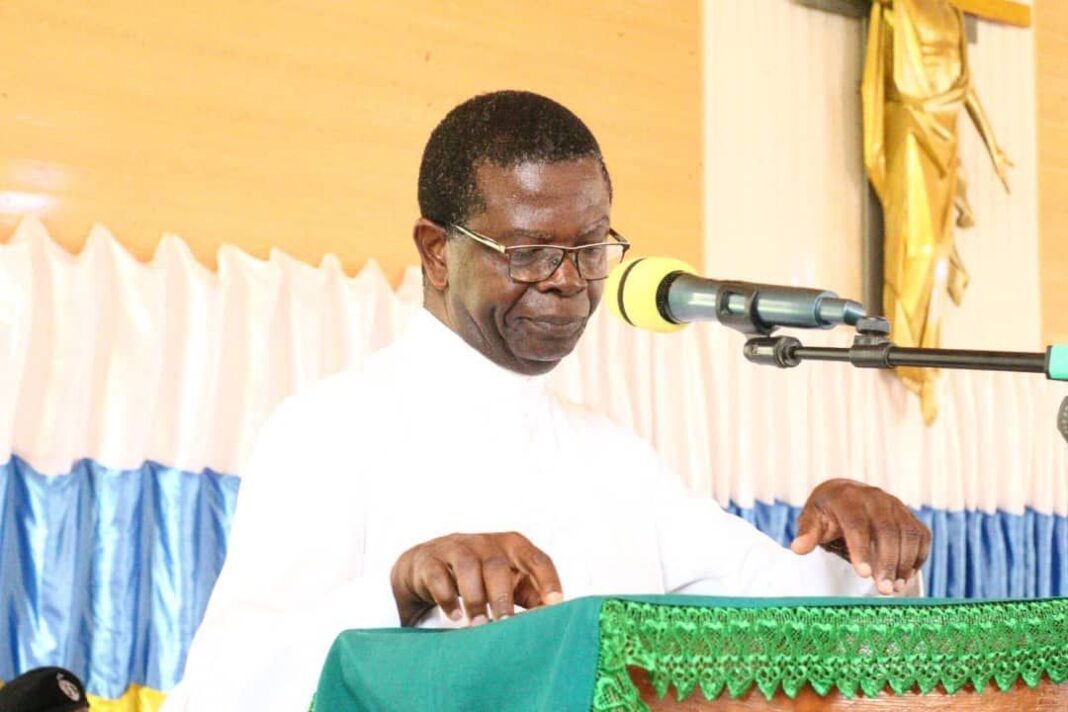

The Holy Father, Pope Leo XIV has accepted the resignation from the pastoral care of the diocese of Jasikan, Ghana, presented by His Excellency Msgr. Gabriel Akwasi Ababio Mante, and has appointed as Bishop, the Rev. Fr. Prof. Simon Kofi Appiah, currently a lecturer in the Department of Religion and Human Values at the University of Cape Coast.
Bishop-Elect Simon Kofi Appiah was born on July 1, 1964, in Teteman, Ghana. He completed his philosophical and theological studies at St. Peter’s Regional Seminary in Pedu, Cape Coast, Ghana.
He was ordained a priest for the then Diocese of Keta Ho on July 21, 1990. Upon the creation of the new Diocese of Jasikan in 1994, he was incardinated in it.
He has held the following positions and carried out further studies: Parish Vicar at the Communities of Kpedze, Vakpo and Kadjebi (1990-1995); Studies at the University of Tübingen, Germany (1995-2001); Doctorate in Theological Ethics; Post Graduate Diploma in Psychology at the University of London; Diploma in Teaching Higher Education at the Catholic University of Eastern Africa in Nairobi (Kenya); Formator at St. Patrick Formation House (1999-2001); Diocesan Chancellor and Director of the Diocesan Office for the Pastoral Care of Vocations (2001-2003); Pastoral Collaborator at the Parish of Kadjebi (2003-2011).
Since 2011, he has been a lecturer in the Department of Religion and Human Values at the University of Cape Coast and at the Major Seminary in Pedu.
According to the website of the Diocese, St. Pope John Paul II erected the Catholic Diocese of Jasikan on December 19, 1994, by carving it out of the then Keta-Ho Diocese. Rev. Fr. Gabriel Akwasi Ababio Mante was appointed as its first Bishop.
The Jasikan Diocese occupies the Oti Region constituting 51% of the total land surface area. It is bordered on the north by the Yendi Diocese, on the south by the Diocese of Ho, on the east by the Republic of Togo and on the west by the Volta Lake. The Diocese is made up of eight political districts, namely Jasikan, Kadjebi, Nkwanta South, Nkwanta North, Krachi East, Krachi West, Krachi-Nchumuru, and Biakoye.
There are about twenty (20) ethnic groups within the Diocese. These are Adele, Kwahu, Akuapem, Asante, Akposso, Atwede, Basari, Bowiri, Buem, Challa, Ewe, Kabye, Konkomba, Kotokoli, Krachi, Nawuri, Nchumuru, Nkonya, and Ntrubo. Despite this diversity, none of these ethnic groups holds a dominant cultural and political position in the Diocese. The mixed ethnic composition does not serve as a language barrier, because the Twi and Ewe languages are widely spoken.
The vision of the Diocese is to create a family of God that is at peace with itself and others, prosperous, and just as well as reflecting the gospel values of love, compassion, solidarity, and stewardship of God’s creation. The mission is to evangelize by drawing people to Jesus Christ through pastoral and socio-economic care, as mandated by Christ in Matthew 28:19 and Acts 1:7.
The land surface of the Diocese is largely rural, with a high percentage of illiteracy. Industries and other business ventures that should help diversify economic activities are almost absent. Thus, life is largely organized around subsistence farming and petty trading. The main food items produced include yams, plantain, cassava, rice, and cereals. The area lacks social amenities and road infrastructure.