


The Most Rev. Joseph Osei-Bonsu, Emeritus Bishop of Konongo-Mampong, has revealed that the common practice of Priests asking a congregation to lift offertory envelopes or gifts for a special prayer during Mass is not prescribed in the Roman Missal and violates the Church’s liturgical norms.
In a response to a query from James Osei-Mensah, Bishop Osei-Bonsu described the gesture as not liturgically proper, stating that it “creates a new ritual that the Church has not authorised” despite its good intentions.
“While the desire to invoke God’s blessing on the offerings of the faithful is good and sincere, the method of asking the congregation to raise their envelopes during Mass is not liturgically proper, “he said, adding that “It introduces an unauthorised gesture, shifts the focus away from the Eucharistic sacrifice, and risks confusing the faithful about the true meaning of the offertory.”
He stated, “The Roman Missal gives no instruction for such a gesture, and it represents an addition to the liturgy, which is explicitly discouraged by the Second Vatican Council’s Constitution on the Sacred Liturgy (Sacrosanctum Concilium, 22 §3): “No one, not even a priest, may on his own authority add, remove, or change anything in the liturgy.””
According to Bishop Osei-Bonsu, the General Instruction of the Roman Missal (GIRM, nos. 73-75) states that the offertory involves presenting bread and wine as symbolic gifts that become Christ’s Body and Blood, uniting the faithful’s self-offering with His sacrifice.
He emphasized that though monetary contributions are important for Church needs and the poor, they are not intended for ritual blessing, noting that “the congregation’s attention is drawn to the material gift rather than the spiritual offering of Christ.”
In addition, he referenced 1 Peter 1:18 19 to highlight that grace is not earned through money, reminding that “this notion contradicts the Church’s teaching that God’s grace is freely given and not dependent on the monetary value of one’s offering.”
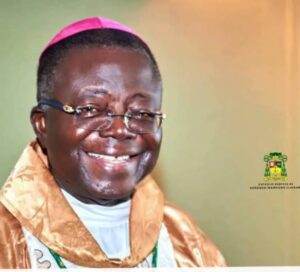
Most Rev. Joseph Osei-Bonsu explained that the correct practice includes an organized procession of gifts, with the priest presenting bread and wine on the altar while reciting approved prayers.
“The faithful may bring their offerings in an orderly and reverent procession to the altar or place them in collection baskets that are later presented to the priest or deacon. The priest then places the bread and wine on the altar and offers the prescribed prayers of blessing”, he said.
He also added that blessings for the congregation should occur outside the offertory, such as in the Prayer of the Faithful, after Post-Communion, or at the end of Mass.
“If a priest desires to thank or bless the congregation for their generosity, he can do so outside the offertory ritual itself”, he said.
While acknowledging priests’ sincere motives, Bishop Osei-Bonsu called for obedience to Church directives to maintain liturgical integrity, stating, “To preserve the beauty, order, and integrity of the sacred liturgy, priests and liturgical ministers must faithfully follow the Church’s directives, avoiding innovations that distract from the mystery of Christ’s presence and self-offering.”

By: Veronica Sena Amenya//Newswatchgh.com
Editor’s Note: The full text will be published