

INTRODUCTION:
Anytime I thought of Easter as a young seminarian, two fond memories come to mind:
- The hope of some of us who hardly received visitors in school, that at least, on Palm Sunday, we would be served boiled yams not with groundnut soup but with palm nut soup. For me, it was as if our Matron, Auntie Konadu, was a practical theologian! It was a delicacy that never failed. So, at Mass, our attention was not on the long Homily but on the boiled yams with our favourite palm nut soup. Only God knew how we waited eagerly to console ourselves with that.
- The fever of the chant of the Exultet by our Deacons in the Major Seminary. I am sure a good number of Priests who neither had a good voice nor knew how to sing had their share.
Growing up and maturing in the faith, I got to realise that Palm Sunday goes beyond my infantile thoughts in the Minor Seminary. I am sure I am not the only victim, but a good number of Catholic families think the same, if not most!
WHAT PALM SUNDAY IS ALL ABOUT:
As you and I may know, Palm Sunday ushers us into the Holy Week: holy in the sense that it ushers us into the Paschal Mystery: the Suffering, Death, and Resurrection of Christ that saves us.
In fact, it is in that week that we celebrate the One Celebration, which lasts for three continuous days, and which is traditionally called the Triduum. The Triduum begins with the Mass of the Lord’s Supper on Holy Thursday, continues through the Good Friday Service (Veneration of the Cross), and ends with the Easter Vigil on Holy Saturday night, the eve of Easter Sunday.
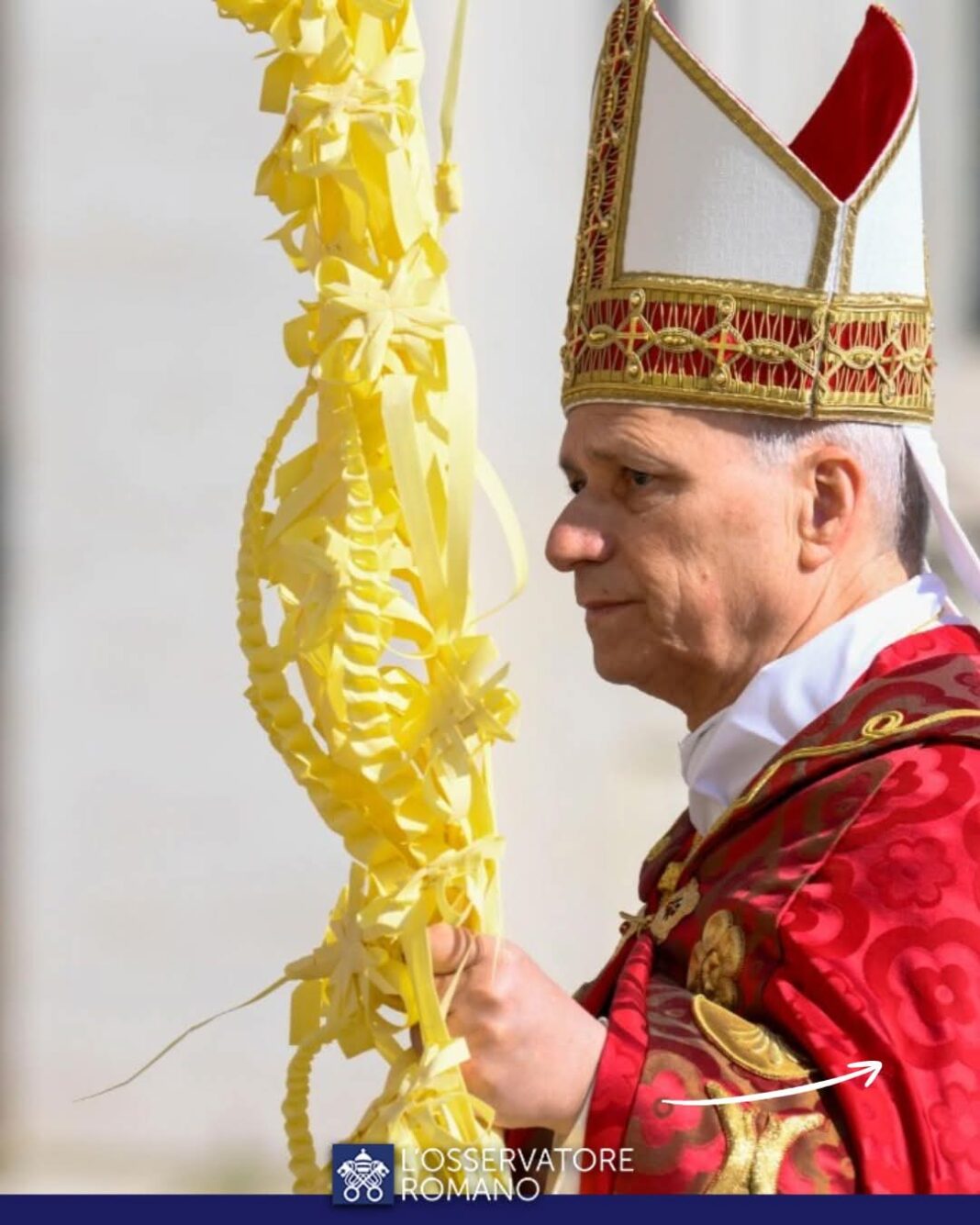
Again, Palm Sunday is also called The Passion Sunday because Mother Church invites us to the genesis of the Suffering and Death of Jesus, which is to come, and She opens it with Palm Sunday as we sing, “Hosanna! Here comes our King, the King of David. Blessed is He who comes in the name of the Lord.” (Mark 11:9ff)
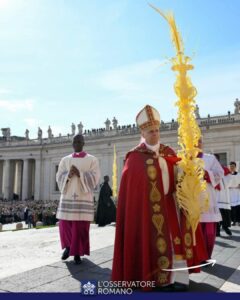
So, it is for this reason that we wear red (which signifies love – a love that sacrifices and dies), and read the Passion Narrative/Reading according to the liturgical Cycle (if we are in Year A, we read Matthew, etc…).
WHAT ACTUALLY HAPPENED ON PALM SUNDAY:
Historically, the people of Israel were fed up with the leadership of the nation. So their chant of Hosannah was like a cry for rescue, a yearning for hope in Jesus to overturn and overthrow the government and become their new King. Still, the King who sits on a donkey says, “My Kingship is not like that of the world, but a servant Kingship – one that serves, one that is meek and humble of heart. That would turn their high hopes to hopelessness, making them call for his Crucifixion.
IN PLACE OF PALM BRANCHES:
Interestingly, in most European countries, sometimes in place of Palm branches, Olive branches are used. My first use of Olive branches in Rome as a seminarian was psychologically hard to accept this pastoral reality. It makes no difference, and know that the Palm branches represented a great victory.

In some cultures, when a young person dies a tragic death, the casket is decorated with Palm branches as a sign that, though young, he or she has triumphed over death and even over sin.
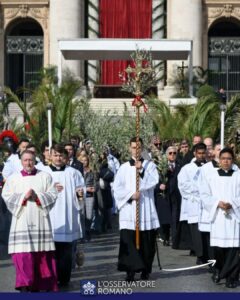
So the celebration ordinarily begins in front of or outside the Church with a procession; however, in certain pastoral situations, there may be a simple entrance or no procession at all.
THE TAKE-HOME ON PALM SUNDAY:
- It is an invitation to each one of us to joyfully enter ‘Jerusalem’ with Jesus to celebrate the Passover, where eventually, Jesus becomes our New Passover.
- Unlike the Jewish Passover, where the head of the family retold the history and tragedy of their migration from Egypt to Canaan, Jesus rewrites the genesis of a new history of mankind.
- It is not only about the Israelites who ate bitter herbs yearly, we too undergo healing and transforming dessert experiences – moments that restore our hope, quashing our fears and anxieties.
- It is humbling to each one of us that the Master requires us just as He needed the donkey (an animal that symbolises humility and docility). The Master needs our talents and even our challenges and defects to transform us once we open our hearts and accept His invitation.
- Just as He needs us, St Augustine says, sometimes we need God’s grace to untie us, God’s grace to set us free to go to the Master.
CONCLUSION:
It is clear, therefore, that Palm Sunday goes beyond enjoying palm nut soup, palm wine, and enjoying a beautiful yearly chant in procession through the principal streets of our towns and villages, but a call to enter into the Mystery of our Salvation and make some resolutions in our Christian journey to get loosened for Him since the Master needs each one of us.
Nevertheless, as you enjoy your palm nut soup, palm wine, and others, I wish you a Happy Palm/Passion Sunday, Beloved-In-Christ!
By Rev. Fr. Albert Kyei Danso
Chaplain, Ghanaian Catholic Community Church, Pordenone -Italy