

At a national policy dialogue on financial inclusion in Accra, Deputy Chief of Staff Nana Oye Bampoe Addo has sounded a strong call for urgent reforms to support Ghana’s vast informal sector, describing it as the “real economy” that remains largely neglected.
Speaking at the event organized by the Centre for Social Justice on Thursday, April 16, 2026, at the Airport View Hotel, Accra, she highlighted the scale and significance of the sector, noting that “80% of our workforce is in the informal sector” and contributes about 58% of Ghana’s GDP.
Despite this, she lamented the lack of financial protection for millions of workers.
“Less than 5% of our informal workers have a pension… over 12 million workers have no pension,” she revealed, adding that many hardworking Ghanaians are left vulnerable in old age.
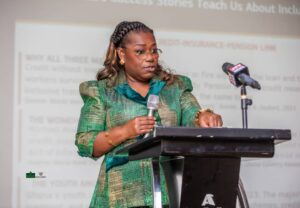
Nana Oye painted a vivid picture of everyday Ghanaians driving the informal economy.
“A grandmother who sells kenkey, Kofi the carpenter… this is the story of Ghana’s real economy – very vibrant, but largely invisible to the formal financial systems,” she said.
She identified a “triple gap” holding the sector back: limited access to credit, lack of insurance, and absence of pensions.
According to her, “credit without insurance means one illness or fire will wipe everything out,” stressing the need for a holistic approach.
The Deputy Chief of Staff also raised concerns about gender inequality, revealing that although women make up 63.4% of the labour force, they receive less than 10% of formal financial services.
“Women… contribute an estimated 40% of informal sector output, but remain the most excluded,” she noted.
Calling the past decade a “lost decade” for informal sector policy, Nana Oye urged stakeholders to act swiftly.
“If we want transformation… we must understand the data and act deliberately,” she emphasized.
By Theresa Kpordzo// Celestine Gbologah