
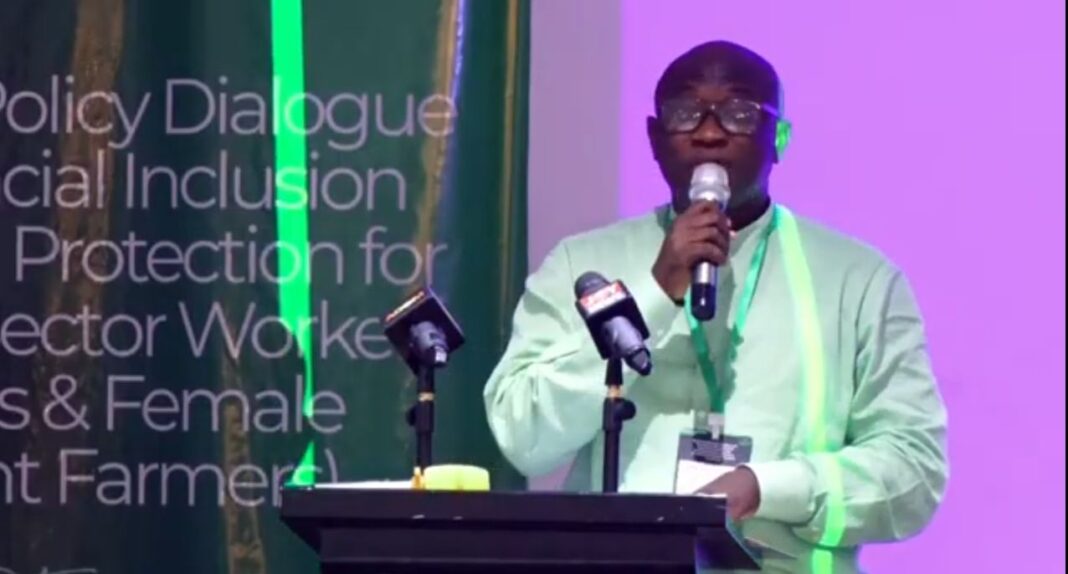

Mr. Raymond Danso, Star Ghana Foundation, has called on financial institutions and policymakers to stop viewing informal sector workers as charity cases and instead recognize them as a powerful economic force driving Ghana’s growth.
Delivering an address at a national policy dialogue on financial inclusion and social protection for informal sector workers, traders, and female peasant farmers in Accra, he emphasized that the informal sector, comprising over 80% of Ghana’s workforce, remains largely excluded from formal financial systems despite its critical role in the economy.
“We need to see the informal sector not as a charity, but as the largest untapped market in the country,” he stressed, urging banks and policymakers to rethink their approach.
Highlighting the daily struggles of ordinary Ghanaians, Mr. Danso painted a vivid picture of hardworking women and farmers who form the backbone of the economy.
“I’m talking about the women who begin their day at 4 am… the small farmer in Tamale whose harvest feeds us in the city,” he said.
He pointed out a troubling paradox in Ghana’s financial landscape: while digital banking and mobile money continue to expand, many traders and farmers still face deep barriers to access.
“We see digital banking, yet our farmers in the hinterlands still struggle with a massive trust gap,” he noted.
According to him, complex financial systems and high costs continue to push informal workers away, citing high processing fees and rigid requirements as major obstacles.
“Insurance and pension schemes appear like a complex puzzle designed for salaried elites,” he added.
Mr. Danso also highlighted structural challenges such as a lack of collateral and high-interest loans, revealing that in some regions, “loans are issued at as high as 28%, yet access to credit remains extremely limited.”
Despite these challenges, he acknowledged progress made through partnerships with the Centre for Social Justice, including the formation of cooperatives and financial literacy training for women’s groups. However, he noted that these efforts alone are not enough.
“Our interventions have limits… we need to work as an ecosystem,” he said.
Drawing lessons from countries like Kenya and India, he emphasized the importance of coordinated national action.
“The success was not just about technology, but deliberate partnerships,” he explained.
He called on key institutions to step up, urging the Bank of Ghana to support innovative micro-insurance and the Ministry of Trade, Agribusiness and Industry to strengthen value chains to make farmers more bankable.
Mr. Danso challenged stakeholders to move beyond discussions and focus on practical solutions. “Let’s focus on the ‘how’… how do we simplify insurance, how do we protect both lender and borrower?” he asked.
Reaffirming Star Ghana’s commitment, he concluded with a call to amplify grassroots voices, “We want to ensure that the voices of these women and farmers are not just heard, but reflected in policies and strategies.”
The dialogue forms part of ongoing efforts to push for inclusive economic reforms and bridge the gap between Ghana’s informal sector and formal financial systems.
By Theresa Kpordzo