
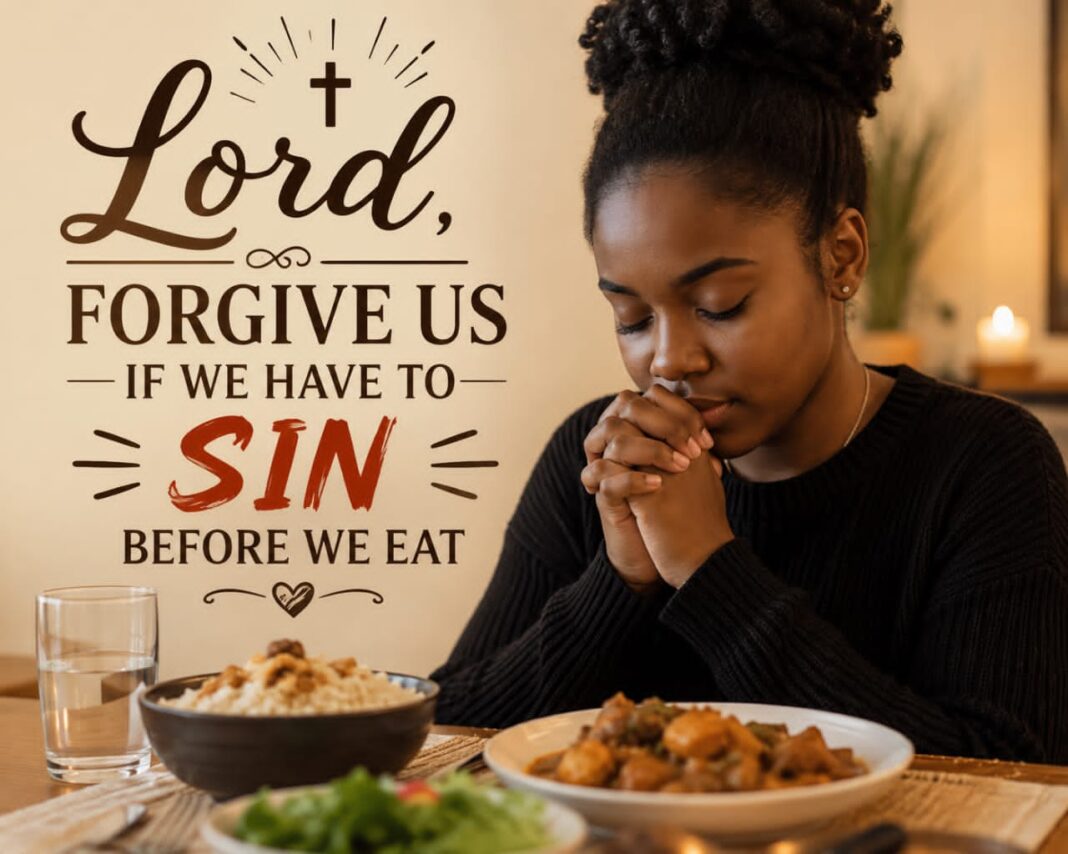

About a year ago, while travelling from Winneba to Kaneshie, my attention was drawn to an inscription on the rear of a trotro: “Lord, forgive us if we have to sin before we eat.” At first glance, it seemed like another of the many religious slogans that adorn public transport in Ghana. Yet the more I reflected on it, the more I realized that these few words contain an entire philosophy of human existence and a profound theology of grace, justice, and hope.
Why should a person sin before eating?
What could be the cause of such a prayer?
Is the inscription a prayer or an existential cautious outcry?
The inscription is both a prayer and a protest. It is addressed to God, yet it indicts society. It confesses human weakness while exposing social injustice. It asks for forgiveness, but it also questions a world in which survival sometimes appears to demand moral compromise.
The statement immediately recalls Aristotle’s understanding of the purpose of political society. In the Nicomachean Ethics, Aristotle argues that the ultimate goal of society is eudaimonia, human flourishing, which can only be achieved through the cultivation of virtue within a just political community (Aristotle, trans. Ross, 2009, Bk. I). Virtue is not formed in isolation; it is nurtured in communities that provide conditions for people to live dignified lives. Consequently, when economic systems deprive citizens of the basic necessities of life, they also undermine the cultivation of virtue.
This concern becomes even clearer in the philosophy of Immanuel Kant. According to Kant (1785/1997), every human being possesses an inherent dignity because every person is an end in himself or herself and must never be treated merely as a means. Hunger, unemployment, and exploitation, however, often reduce individuals to instruments of survival. The poor are sometimes compelled to compromise their integrity, not because they despise morality, but because society has failed to protect their dignity.
The existential dimension of the inscription is illuminated by Viktor Frankl (2006, p. 75), who famously wrote: “Everything can be taken from a man but one thing: the last of the human freedoms to choose one’s attitude in any given set of circumstances.”
Frankl acknowledges that external conditions profoundly influence human behaviour without entirely destroying moral freedom. His insight invites compassion rather than quick condemnation of those who struggle under extreme hardship.
The French philosopher Paul Ricoeur (2004) deepens this reflection by arguing that forgiveness belongs to the highest expressions of hope because it refuses to reduce persons to their failures. Forgiveness does not erase responsibility; rather, it opens the possibility of moral renewal. Thus, the trotro inscription is fundamentally an appeal to divine mercy, rather than an excuse for wrongdoing.
Similarly, Emmanuel Levinas (1969) insists that ethics begins with responsibility for the face of the Other. The hungry face is not merely a social statistic; it is an ethical summons demanding a response. Before asking why some people commit desperate acts, society must first ask why so many people remain hungry in the midst of abundance.
The inscription also invites social analysis. Karl Marx (1867/1976) argued that unjust economic structures often alienate human beings from their labour, from one another, and from their own humanity. Although Christianity differs profoundly from Marx regarding religion and human destiny, his critique reminds us that economic systems can create conditions in which moral choices become painfully constrained.
Theologically, the inscription echoes the biblical tradition of lament. It resembles the cry of the Psalmist: “Out of the depths I cry to you, O Lord” (Psalm 130:1).
This is not the voice of rebellion but of desperate faith. The prayer assumes that God listens even when human beings struggle.
The statement also recalls Christ’s temptation in the wilderness (Matthew 4:1–11). After forty days without food, Satan invited Jesus to transform stones into bread. Jesus responded: “Man shall not live by bread alone, but by every word that proceeds from the mouth of God” (Matthew 4:4).
Jesus does not deny the importance of bread. Rather, He refuses to obtain legitimate goods through illegitimate means. His response reveals that authentic human life requires both physical nourishment and moral fidelity.
Nevertheless, Christianity also recognizes the complexity of moral responsibility. St. Augustine observed: “God had one Son on earth without sin, but never one without suffering” (Augustine, Sermons).
Suffering belongs to human existence. The Christian, therefore, approaches those who fail not first with condemnation but with compassion.
This understanding reaches its theological depth in St. Thomas Aquinas, who teaches that mercy is “the greatest of the virtues relating to our neighbour” because it imitates God’s own compassion (Summa Theologiae, II-II, q.30, a.4). God’s justice is always accompanied by mercy.
Modern Catholic Social Teaching expands this perspective. St. John Paul II (1987) introduced the concept of “structures of sin,” arguing that unjust social, political, and economic systems can encourage individuals toward wrongdoing. While personal responsibility remains, society also bears responsibility whenever corruption, exploitation, or inequality become normalized.
Likewise, Pope Benedict XVI (2009, §36) insists in Caritas in Veritate that authentic development must unite economic progress with truth, justice, and charity. An economy detached from ethics ultimately dehumanizes the very people it claims to serve.
Building on this tradition, Pope Francis (2013, §53) writes in Evangelii Gaudium: “Such an economy kills.”
His statement captures the moral urgency hidden within the trotro inscription. Economic systems that deprive people of dignified work do not merely create poverty; they also create moral crises.
The insights of Gustavo Gutiérrez (1973) further illuminate the theological significance of the slogan. Liberation Theology teaches that God’s preferential option for the poor is not a political slogan but a biblical conviction. God consistently hears the cry of the oppressed and calls believers to transform unjust structures. Feeding the hungry, defending the vulnerable and promoting justice are not optional acts of charity; they are essential expressions of Christian discipleship.
The Catechism of the Catholic Church (1992, §§1868–1869) reinforces this teaching by explaining that sin possesses both personal and social dimensions. Individuals become responsible not only for the sins they commit directly but also for social conditions that encourage injustice and weaken moral life.
Ultimately, the most remarkable word in the inscription is not “sin” but “Lord.” The driver begins with God because hope begins with God. The prayer recognizes that divine mercy is greater than human weakness and that grace remains possible even amid economic despair.
The words painted on that trotro continue to challenge every traveler: Can a society truly call itself just if honest work no longer guarantees daily bread? Can we preach morality without also confronting the poverty that threatens it?
Perhaps the answer lies in the prayer itself. It is both confession and commission. It asks God to forgive our failures while calling us to build a world where no one must choose between conscience and survival.
May we therefore pray not only, “Lord, forgive us if we have to sin before we eat,” but also, “Lord, help us build a society where every person can eat without having to sin.”
By Rev. Fr. Augustine Obeng Kwaku.