


The Knights of St. John International and Ladies’ Auxiliary (KSJI) Ghana has called on Ghanaians to embrace national accountability, justice and environmental stewardship, insisting that the country’s challenges cannot be left to leaders alone but require collective action from citizens and faith communities.
The Supreme Subordinate President of KSJI Ghana, Maj. Gen. (Ing.) Sir Joseph Charles Osei, said the Order’s commitment to Ghana’s development goes beyond words and must be demonstrated through practical action that promotes the welfare of citizens and the common good.
He made the remarks in his welcome address at the maiden Annual St. John the Baptist Memorial Lectures, organised by the Supreme Subordinate Commandery and Ladies’ Auxiliary of KSJI Ghana on Tuesday, October 13, 2026, at the Christ the King Parish Hall in Cantonments, Accra.
The lecture was held on the theme, “Speaking Truth to Power: Upholding Justice, Morality and National Accountability.”

Sir Osei said the establishment of the lecture was inspired by the example of St. John the Baptist, the Patron Saint of the Noble Order, whose life demonstrated courage in speaking the truth and standing for righteousness and justice, even when doing so came at a personal cost.
He explained that the saint’s example remains relevant to Ghana’s present circumstances, particularly in confronting corruption, injustice, environmental destruction, weakened institutions and the neglect of vulnerable people.
Reflecting on the responsibility of citizens to speak against wrongdoing, he challenged the audience to consider whether St. John the Baptist would remain silent in the face of the challenges confronting the country.

“I believe the answer is clear. St. John the Baptist would speak,” he declared.
He added that the Saint would speak not to gain popularity but because remaining silent in the face of wrongdoing could amount to a failure of moral responsibility.
Sir Osei said the Memorial Lectures were intended to provide a platform for reflection on truth, morality, justice and accountability, while encouraging citizens to take a more active role in national development.
“The challenges confronting Ghana cannot be somebody else’s concern. They are our concern,” he stressed.
He explained that KSJI’s commitment to God and Country requires the Order to look beyond its membership and consider how it can contribute to the advancement of the wider society.
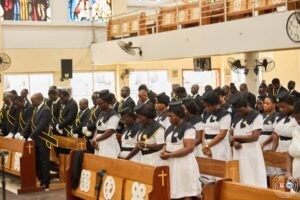
KSJI is a Catholic fraternal paramilitary organisation founded on the principles of faith, charity, justice, fraternity and service. Its presence in Ghana dates back to 1933, and for more than nine decades, it has sought to contribute to the spiritual and social development of its members and the welfare of communities across the country.
Sir Osei noted that the Order has consistently expressed concern about issues of national importance, including illegal mining, popularly known as galamsey; challenges surrounding school placement; and the work of the Constitutional Review Commission and its ongoing processes relating to constitutional development and governance.
He said the Order had also contributed to national discussions on the protection of moral and cultural values, particularly concerning the Promotion of Proper Human Sexual Rights and Ghanaian Family Values Bill, alongside other matters affecting the country’s development and well-being.

He emphasised that the Order’s interventions were not motivated by partisan interests but by the belief that citizens, institutions and faith communities have a responsibility to contribute constructively to national discourse.
“Our interventions are not motivated by partisan considerations. They arise from a conviction that responsible citizens, institutions and faith communities have a duty to contribute constructively to the national conversation,” he said.
Sir Osei maintained that speaking about national challenges must be accompanied by practical efforts to address them, highlighting the Order’s humanitarian and environmental initiatives as examples of its commitment to service.
He disclosed that KSJI Ghana had made significant donations to support people affected by the Akosombo Dam spillage, which impacted communities in parts of the Volta and the Greater Accra Regions.
The Order also undertook a nationwide tree-planting exercise in June 2026, during which more than 16,000 tree seedlings were planted in various parts of the country.
According to Sir Osei, the exercise demonstrated the Order’s commitment to environmental stewardship and its responsibility to protect the country for future generations.
He announced that the tree-planting initiative would become an annual activity to promote environmental sustainability across Ghana.
“These may be small but meaningful expressions of a much larger principle: that our faith must find expression in service, and our service must make a difference in society,” he said.

The Supreme Subordinate President further called on citizens to recognise that accountability is not solely the responsibility of political leaders and public officials but also a duty that extends to everyone who exercises influence or authority.
He observed that power takes different forms, including political, institutional, economic, religious, traditional and professional influence, as well as the authority individuals exercise within their families and communities.
He therefore urged the public to reflect on their own responsibilities and willingness to uphold ethical standards.
“The question before us is not simply whether those in authority are accountable. The question is also: Are we accountable?” he asked.
He challenged citizens to consider whether they are prepared to speak the truth when doing so is difficult, defend what is right when it is unpopular, and hold themselves, their institutions and their leaders to standards of justice, morality and integrity.

He also underscored the importance of listening when the truth is spoken, noting that accountability requires people not only to challenge wrongdoing but also to be willing to receive difficult messages and examine their own conduct.
The memorial lecture also brought together members of KSJI from Ghana, Nigeria, Liberia and Togo, underscoring the international character of the Order and its shared commitment to faith, service, justice and the common good.
Sir Osei welcomed the visiting members, describing their presence as an opportunity to strengthen the bonds of fraternity among members across national boundaries.

He also acknowledged the presence of representatives of the Church, traditional authorities, public institutions, civil society, academia, the media and other guests, whose participation added significance to the occasion.
The keynote address was delivered by Justice Sir Dennis Dominic Adjei, a Justice of the Supreme Court of Ghana and a Judge of the African Court on Human and Peoples’ Rights, Arusha, Tanzania. Distinguished panellists also contributed to the discussions.
Sir Osei expressed the hope that the St. John the Baptist Memorial Lectures would develop into a lasting platform for meaningful national engagement rather than remain an annual ceremonial event.
“May it become a platform for truthful reflection, responsible dialogue, moral courage and constructive national engagement,” he said.
He further urged participants to translate the discussions into practical commitments that would benefit society.

“May it inspire us to move from conversation to action, from concern to commitment, and from words to service,” he added.
He said honouring St. John the Baptist requires more than remembering his life; it demands a willingness to uphold the principles he represented.
The inaugural St. John the Baptist Memorial Lecture therefore marks an important step in KSJI Ghana’s efforts to encourage national reflection on justice, morality and accountability, while reinforcing the role of faith-based organisations in contributing to the country’s development.
The Order’s message was clear: building a just, responsible and accountable society requires not only leaders who are willing to answer for their decisions but also citizens who are prepared to speak truth, listen with humility and translate their convictions into meaningful service.
By Celestine Edem Gbologah and Robert Dela Mawuenyegah