
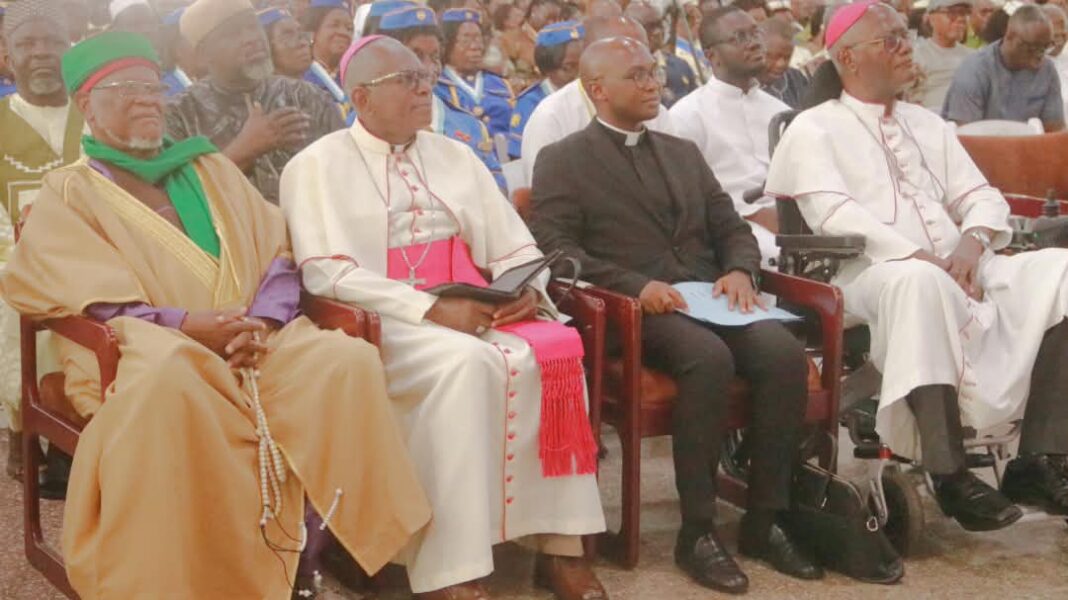

The Apostolic Nuncio to Ghana, His Excellency Most Rev. Julien Kaboré, has cautioned that speaking truth to power must not become an excuse for hostility, bitterness or unnecessary confrontation, but must be rooted in charity, prudence and respect for human dignity.
He said that while St. John the Baptist remains an outstanding example of courage and fidelity to truth, Christian prophetic courage must recognise that those in public authority remain brothers and sisters deserving of prayers, encouragement and constructive correction.
Most Rev. Kaboré made the remarks in his goodwill message at the maiden Annual St. John the Baptist Memorial Lectures, organised by the Supreme Subordinate Commandery and Ladies’ Auxiliary of the Knights of St. John International (KSJI) Ghana on Tuesday, October 13, 2026, at the Christ the King Parish Hall in Cantonments, Accra.
The lecture was held on the theme, “Speaking Truth to Power: Upholding Justice, Morality and National Accountability.”
The Nuncio said the theme is particularly relevant to Ghana and many other nations, as it offers an opportunity to reflect upon the fundamental values upon which a just, peaceful and prosperous society must be built.
He described St. John the Baptist, the Patron Saint of the Noble Order, as an outstanding example of courage, integrity and fidelity to the truth, recalling Pope Benedict XVI’s Angelus address of June 24, 2007, where the Pope noted that John bore witness to the truth without compromise, even when it meant confronting those in authority.
“His denunciation of Herod’s unlawful conduct eventually cost him his life,” he said, adding that the saint’s example reminds Christians that truth, justice and moral responsibility cannot be sacrificed to personal interests, political convenience or the desire for public approval.
Quoting the Christian vocation, he said through Baptism every Christian shares in the prophetic mission of Christ and is therefore called to bear witness to the truth, in words and, above all, through the integrity of daily life.
He cautioned, however, that prophetic courage must be distinguished from hostility.
“However, speaking truth to power must never become an excuse for hostility, bitterness or unnecessary confrontation. The Christian understanding of prophetic courage is inseparable from charity, prudence and respect for human dignity,” Most Rev. Kaboré stated.
He added that the Church seeks to promote justice through dialogue, persuasion and peaceful engagement without compromising the truth, citing Canon 1446 §1, which encourages that conflicts should, as far as possible and without prejudice to justice, be resolved peacefully.
“This approach should never be mistaken for indifference or weakness. Indeed, genuine dialogue often requires considerable courage, patience and perseverance,” he noted.
Addressing public office holders present, the Nuncio said public office is above all a vocation to service.
“Authority finds its noblest expression when exercised for the common good, especially in favour of the poor, the vulnerable and those whose voices are seldom heard,” he said.
He invoked the Ghanaian proverb, “A good name is better than riches,” saying it contains wisdom that deserves to be remembered by all who exercise authority, as positions of responsibility are temporary but the consequences of decisions and legacies may endure for generations.
“In this regard, the words of Jesus remain particularly challenging: ‘Whatever you did for one of the least of these brothers and sisters of mine, you did for me’ (Mt 25:40),” he added.

The Apostolic Nuncio concluded by recalling three essential dimensions of the vocation of St. John the Baptist highlighted by Pope Francis in his homily of June 24, 2014: to prepare, to discern and to diminish.
On preparation, he said Christians are called to prepare the way of the Lord, creating conditions in which truth, justice, reconciliation and peace can flourish.
On discernment, he urged the faithful and leaders to distinguish what is right from what is merely convenient, and what serves the common good from what promotes personal or sectional interests, noting that such discernment requires an upright conscience, wisdom and openness to the Holy Spirit.

On diminishing, he described it as perhaps the most demanding lesson, quoting John the Baptist: “He must increase, but I must decrease” (Jn 3:30).
“True leadership requires humility, the willingness to serve without seeking personal glory, and the courage to place the good of others before oneself,” Most Rev. Kaboré said.
He said these three attitudes — preparation, discernment and humility — offer a valuable programme of life for Christians, public authorities and all people of goodwill.

He congratulated KSJI Ghana for organising the Memorial Lecture and encouraged members to remain faithful to the noble ideals of their Patron Saint.
“May your commitment to truth, justice, charity and service continue to bear abundant fruit in the Church and in Ghanaian society,” he prayed.
He invoked the intercession of the Blessed Virgin Mary, Queen of Prophets, for Ghana and all those entrusted with guiding its destiny, concluding with the Psalmist’s prayer: “In his days justice shall flourish, and peace till the moon fails” (Psalm 72:7).

By Robert Dela Mawuenyegah and Celestine Edem Gbologah