
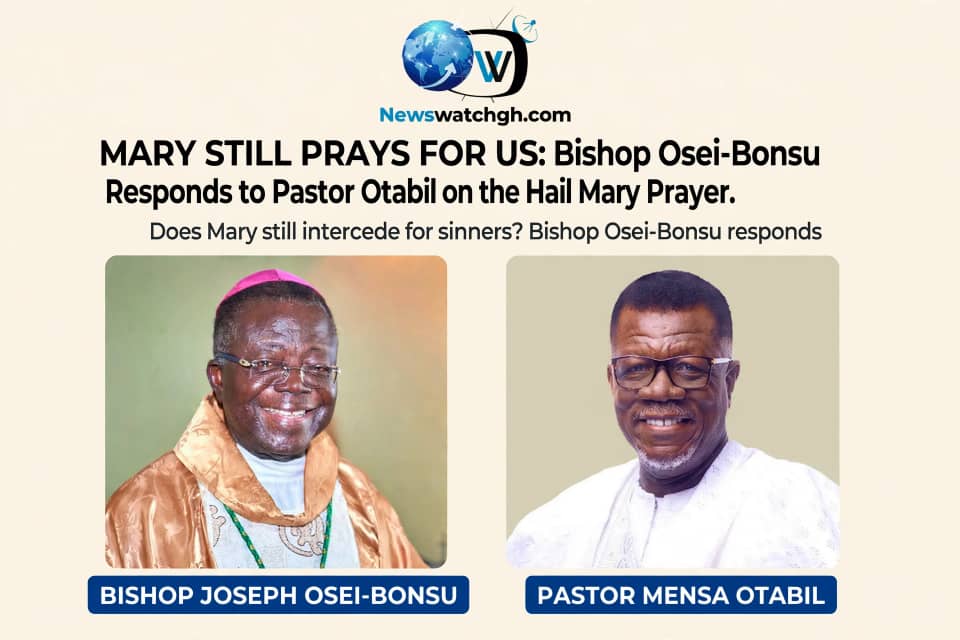

Does the Blessed Virgin Mary still intercede for sinners?
In a clear and pastoral response to a claim attributed to the Founder and General Overseer of the International Central Gospel Church (ICGC),
Pastor Mensa Otabil that Mary “does not do that,” Emeritus Bishop of Konongo-Mampong Diocese, Most Rev. Joseph Osei-Bonsu, says Scripture, tradition, and the faith of the Church point to the opposite conclusion: Mary prayed for others at Cana, and she has not stopped praying for us now.
The Catholic Prelate responds to a question posed by Cornelius Dordonu in Accra:
My Lord, could you please comment on the following statement attributed to Pastor Mensa Otabil?
‘Hail Mary, full of grace, the Lord is with you. Blessed are you among women. If you are Catholic, you can continue — but do not complete the prayer with the words, “Pray for us sinners,” because she does not do that.’
I consider this statement erroneous. Even while she was still on earth, the Blessed Virgin Mary interceded for the couple at the wedding feast of Cana (John 2:1–12), bringing their predicament to the attention of her Son. Could you please explain further why the statement is contrary to Catholic teaching, particularly regarding Mary’s role as an intercessor and the theological basis for asking her to pray for us?
Answer by Most Rev. Joseph Osei-Bonsu:
Pastor Mensa Otabil’s statement is mistaken on two counts: it misrepresents what Mary did during her earthly life and overlooks what the Church believes she continues to do now. The question is not simply whether Mary interceded for others while she was on earth, but also whether the communion of the faithful continues beyond death and whether Christians may ask those who are in heaven to pray for them.
A Legitimate Concern
The pastor’s concern is probably that the honour given to Mary might become the worship that belongs to God alone. The Catholic Church shares that concern and teaches that worship is due to God alone.
Moreover, the first half of the Hail Mary, to which he appears to raise no objection, comes from Scripture. ‘Hail, full of grace, the Lord is with you’ is the greeting of the angel Gabriel (Luke 1:28), and ‘Blessed are you among women’ echoes the words of Elizabeth (Luke 1:42). The disagreement concerns the second half of the prayer and what it asks.
What the Hail Mary Asks
The second half is a petition of the Church: ‘Holy Mary, Mother of God, pray for us sinners, now and at the hour of our death’ (CCC 2676–2677). The prayer had taken its present form by the sixteenth century, and the Roman Breviary of 1568 included it.
The petition does not ask Mary to save us, to forgive our sins or to grant grace on her own authority. It asks her to pray for us, as one Christian asks another. The Catechism observes that in saying these words we acknowledge ourselves to be poor sinners and turn to the Mother of Mercy (CCC 2677). ‘Sinners’ is therefore the right word, because it is true.
Mary at Cana (John 2:1–12)
At the wedding in Cana the wine ran short. Mary noticed the need and brought it to her Son: ‘They have no wine’ (John 2:3). His answer seems at first to hold her back, for he says that his hour has not yet come (John 2:4). Yet she tells the servants, ‘Do whatever he tells you’ (John 2:5), and he performs what John calls the first of his signs (John 2:11).
Three features mark her role: she sees the need; she does not remedy it herself but brings it to Jesus; and she turns the attention of those present towards him. The Church has long read this as a picture of her intercession (CCC 2618), and Pope St John Paul II describes how Mary places herself between her Son and people in their needs (Redemptoris Mater 21).
This scene answers the claim that she ‘does not do that’. If she interceded for a couple at a wedding while still on earth, nothing in Scripture suggests that she has stopped now that she is united with her Son in glory.
The Saints Are Alive in Christ
Pastor Otabil’s statement assumes that intercession ends with death. Scripture points the other way. Jesus teaches that God is not the God of the dead but of the living, for all live to him (Luke 20:38). Paul is certain that neither death nor life can separate us from the love of Christ (Romans 8:38–39), and the Letter to the Hebrews speaks of ‘so great a cloud of witnesses’ surrounding believers (Hebrews 12:1).
In Revelation, the elders in heaven offer before the Lamb golden bowls of incense, which represent the prayers of the saints (Revelation 5:8; cf. 8:3–4). In 2 Maccabees, Onias and Jeremiah are depicted interceding for the people after their death (2 Maccabees 15:12–14).
The Second Vatican Council teaches that, having been assumed into heaven, Mary did not lay aside her office of intercession but continues, through her constant intercession, to obtain for us the gifts of eternal salvation (Lumen Gentium, 62).
Nor is this the forbidden consulting of the dead. Scripture rightly condemns seeking hidden knowledge from the dead through mediums (Deuteronomy 18:10–11). Catholics do nothing of the kind. They ask members of the one Church, who are alive in Christ, to join them in prayer (CCC 954–956).
Asking for Prayer Is a Biblical Habit
Paul repeatedly asks the churches to pray for him (Romans 15:30; Ephesians 6:19; 1 Thessalonians 5:25), and James teaches that the prayer of a righteous person has great power (James 5:16). Nobody supposes that Paul competes with Christ when he asks for prayer. In the same way, asking Mary to pray for us does not compete with Christ.
The One Mediator
Paul teaches that there is one mediator between God and men, the man Christ Jesus (1 Timothy 2:5), and the Church holds this firmly. The Second Vatican Council states that Mary’s motherly role in no way obscures or diminishes the unique mediation of Christ but shows its power, and that her intercession depends entirely on his (Lumen Gentium 60 and 62). Her prayer is a sharing in his mediation, not a second mediation beside it. As at Cana, it points to her Son.
The Queen Mother
In the kingdom of David, the king’s mother held an honoured place at court. When Bathsheba, as queen mother, comes to King Solomon with a petition, he rises to meet her, bows to her and seats her at his right hand (1 Kings 2:19–20). Many Catholic commentators see here a pattern fulfilled in Mary, the mother of the Davidic King whose kingdom has no end (Luke 1:32–33).
The Witness of Tradition
One of the oldest known prayers addressed to Mary, the Sub tuum praesidium, generally dated to the third or fourth century, appeals to the Mother of God not to despise the petitions offered to her in times of need, but to deliver the faithful from danger.
Writing in the second century, St Irenaeus presents Mary as the advocate of Eve (Against Heresies, 5.19.1). From the cross, Jesus entrusted his mother to the beloved disciple and the disciple to her (John 19:26–27). The Church has traditionally understood this gesture as signifying Mary’s spiritual motherhood and her continuing maternal care for all Christ’s disciples.
The Council of Ephesus, in AD 431, affirmed Mary’s title ‘Mother of God’ (Theotokos). The aim was not to raise her to divine status, but to safeguard the truth that the child she bore, Jesus Christ, is truly God and truly man.
Heaven Is Not Less Charitable than Earth
Finally, consider the logic of the claim. It implies that Mary, who was full of grace on earth and is now in the presence of God, is less able or less willing to pray for sinners than she was at Cana. Yet Scripture teaches that love never ends (1 Corinthians 13:8) and that the righteous in heaven have been made perfect (Hebrews 12:23). If love is perfected in glory, Mary’s love for sinners is not diminished but increased.
Conclusion
Catholics share Pastor Otabil’s concern for the unique place of Christ. The answer to that concern is that Mary does not stand beside Christ as a rival; she stands with us before him. When Catholics say ‘pray for us sinners’, they are not attributing divine power to her. They are asking a member of Christ’s heavenly family to join them in presenting their needs to God through Jesus Christ, the one mediator between God and men (1 Timothy 2:5).
She interceded at Cana, and Scripture shows the saints in heaven praying for others. The Hail Mary asks her to continue what she did there: to bring our needs to Jesus and to direct us to do whatever he tells us.
Most Rev. Joseph Osei-Bonsu is the Emeritus Catholic Bishop of Konongo-Mampong Diocese.