

Vatican News
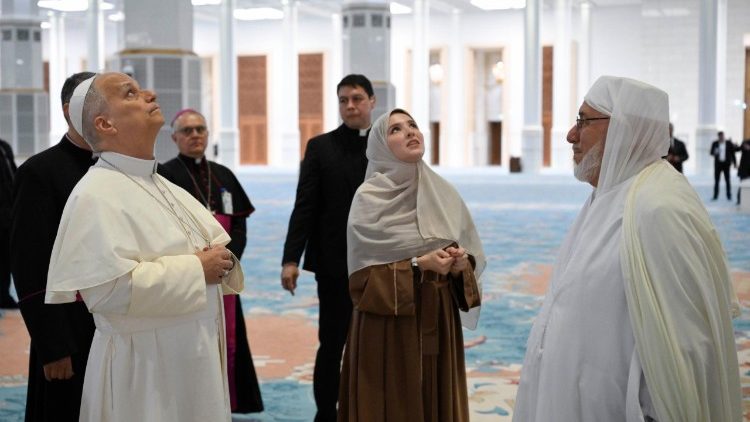
Pope Leo XIV marked the beginning of his apostolic journey to Africa with a visit to the Grand Mosque of Algiers, where he highlighted the site’s spiritual significance and paused in silent meditation.
Welcomed by the Rector of the Mosque, Mohamed Mamoun al Qasim who offered words of fraternity, the Pope said “I thank you for these reflections and for these important words during this visit, from a place that represents the space that belongs to God, a divine and sacred space, where many people come to pray and to seek the presence of the Most High in their lives.”
He went on to recall his personal link to the country through Augustine of Hippo, describing Algeria as “the land of my spiritual father,” and highlighted themes central to his address: the search for truth, the recognition of the dignity of every human being, and the shared responsibility to build peace. “To seek God,” he said, “also means recognising the image of God in every man and woman,” and he said that such recognition calls for mutual respect and coexistence.
The Pope also pointed to the dual religious and intellectual vocation of the mosque complex, noting the importance of developing human knowledge to better understand creation and the dignity of the human person.
He concluded by assuring prayers for the people of Algeria and for all nations, expressing hope that peace, justice, reconciliation, and forgiveness would grow among peoples.
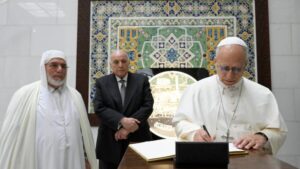
During his visit, the Pope was accompanied by Cardinals George Jacob Koovakad, Prefect of the Dicastery for Interreligious Dialogue, and Jean-Paul Vesco, Archbishop of Algiers. The programme included a guided visit to the mosque, an official photograph, and the signing of the Book of Honour in which the Pope wrote:
The Grand Mosque of Algiers
The Grand Mosque of Algiers was commissioned by former Algerian President, Abdelaziz Bouteflika, as part of his vision of moderate religiosity. It is the third-largest mosque in the world, capable of accommodating up to 120,000 worshippers.
The Mosque’s minaret reaches a height of 267 meters, making it the tallest in the world, while the main prayer hall is surmounted by a large dome, 50 meters in diameter and 70 meters high, whose exterior combines stone decorative elements with golden aluminium panels that create a visual effect that reflects traditional Arab artistic motifs while maintaining a sense of lightness.
Beyond its role as a place of worship, the mosque complex integrates a wide range of cultural and academic functions. It includes a library, research centre, museums, administrative offices, gardens, panoramic terraces, restaurants, and parking facilities, positioning it as both a religious and civic landmark.