

Sir Justice Dennis Dominic Adjei has called for stronger practical protection for people who expose wrongdoing, warning that the victimisation of whistleblowers can discourage others from speaking out and weaken efforts to promote accountability.
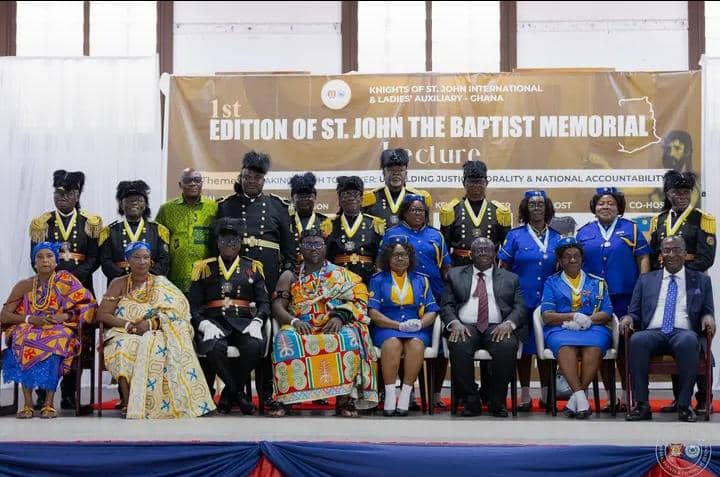
He made the call while delivering the keynote address at the inaugural St. John the Baptist Memorial Lecture organised by the Supreme Subordinate Commandery of the Knights of St. John International and Ladies’ Auxiliary (KSJI), Ghana.
The lecture, held on October 13, 2026, at Christ the King Parish Hall in Cantonments, Accra, was on the theme “Speaking Truth to Power: Upholding Justice, Morality & National Accountability.”
Justice Adjei, a Justice of the Supreme Court of Ghana and Judge of the African Court on Human and Peoples’ Rights, observed that individuals who report wrongdoing can face consequences that extend beyond the immediate complaint, including dismissal, stalled promotions, exclusion from contracts, threats, harassment and social ostracism.
He warned that when people who raise legitimate concerns are punished, others may conclude that remaining silent is safer than exposing misconduct.
According to him, although the example of St. John the Baptist calls for courage in confronting wrongdoing, a constitutional democracy must also establish conditions that allow people to speak up without being exposed to unnecessary personal and professional ruin.
“John’s witness calls us to courage, but a constitutional democracy must build conditions in which courage need not demand ruin,” he stated.
Justice Adjei pointed to the Whistle-blower Act, 2006 (Act 720), as providing a framework for protected disclosures and remedies against victimisation, while emphasising the importance of ensuring that these protections are accessible in practice.
He explained that protection under the law is subject to statutory conditions, including making a disclosure in good faith, having reasonable grounds to believe that the information and allegation are substantially true, and reporting to a recipient specified under the Act.
He cautioned against treating every public accusation as a protected disclosure, stressing the importance of lawful reporting procedures and credible information.

Justice Adjei urged institutions to preserve the confidentiality of whistleblowers, investigate allegations of retaliation and make protective remedies practically accessible to those who need them.
He also emphasised that speaking truth to power must be matched by a willingness on the part of those in authority to listen, assess the evidence fairly and take appropriate corrective action.
The address placed particular emphasis on the role of institutions in ensuring that accountability produces meaningful results rather than ending with the publication of findings or the submission of complaints.
Justice Adjei stressed that the effectiveness of accountability mechanisms should be assessed by examining whether public resources had been recovered where necessary, unlawful practices had stopped, complainants remained safe and corrective measures had been implemented.
He stated: “A published finding with no follow-through is an unfinished exercise in accountability.”
The Supreme Court Justice’s remarks reinforced the central argument of the memorial lecture that speaking truth to power is both a moral undertaking and a constitutional responsibility.

Drawing on the example of St. John the Baptist, who challenged Herod despite the personal cost, the lecture encouraged individuals and institutions to uphold truth and justice while ensuring that legitimate criticism receives a fair and lawful response.
The event brought together KSJI leaders and members from Ghana, Nigeria, Liberia and Togo, representatives of the Knights and Ladies of Marshall, members of the Islamic community, officers of the Ghana Armed Forces, the Metropolitan Archbishop of Accra, Most Rev. John Bonaventure Kwofie, the Auxiliary Bishop of Accra, Most Rev. Anthony Narh Asare, and representatives of the Apostolic Nuncio to Ghana and the Ga Mantse.
The annual memorial lecture seeks to promote reflection on justice, morality and national accountability, while encouraging individuals and institutions to demonstrate integrity in their respective responsibilities.
By Celestine Edem Gbologah//Newswatchgh.com