
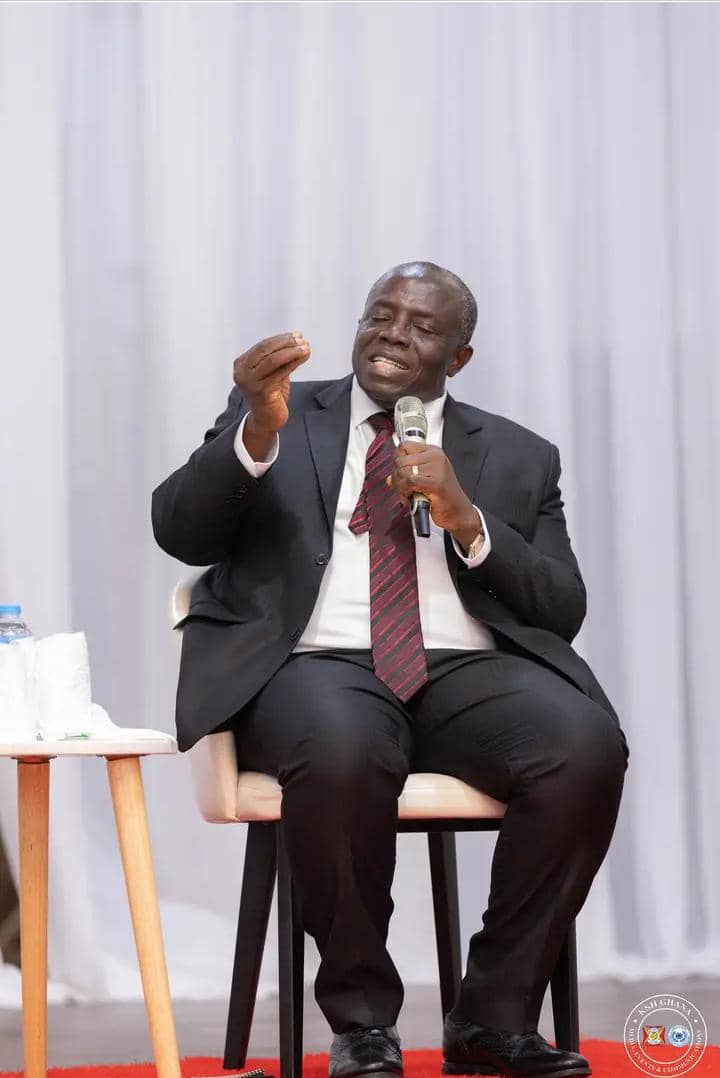

Sir Justice Dennis Dominic Adjei, a Justice of Ghana’s Supreme Court, has cautioned social media users against spreading unverified allegations and manipulated content, stressing that the rapid circulation of information online does not make it credible.
He gave the warning while delivering the keynote address at the inaugural St. John the Baptist Memorial Lecture organised by the Supreme Subordinate Commandery of the Knights of St. John International and the Ladies’ Auxiliary (KSJI), Ghana.
The lecture, held on October 13, 2026, at the Christ the King Parish Hall in Cantonments, Accra, was on the theme “Speaking Truth to Power: Upholding Justice, Morality & National Accountability.”
Justice Adjei, a Judge of the African Court on Human and Peoples’ Rights, Arusha – Tanzania, acknowledged the role social media plays in bringing neglected issues to public attention, but warned that the same platforms can also spread false allegations, manipulated recordings and unjustified suspicion.
He urged users to exercise caution before sharing accusations, encouraging them to establish where information originated, verify the authenticity of the material and examine whether the available evidence supports the claims being made.
“A fabricated image does not become evidence because it has been shared widely,” he stated.
Justice Adjei stressed that the obligations associated with protecting people’s reputations, privacy and lawful rights do not disappear when communication moves online.

His remarks highlighted the need to distinguish responsible criticism from the circulation of unsubstantiated claims, particularly in public discussions involving political leaders, institutions and other individuals in positions of authority.
He also underscored the responsibility of traditional media practitioners to maintain public trust through verification, editorial independence and a clear separation between journalism and paid political promotion.
According to him, responsible journalism requires more than publishing allegations; it demands a commitment to establishing facts, providing context and correcting errors when they occur.
Justice Adjei further noted that the media have a constitutional role in promoting government accountability, while state-owned media are required to provide fair opportunities for divergent and dissenting views.
He cautioned against allowing concerns about misinformation to become a pretext for suppressing legitimate criticism of public officials.
The address also highlighted the responsibility of politicians to apply consistent standards of truth and accountability, regardless of political affiliation.
Justice Adjei observed that public officials who correct errors should not automatically be condemned for acknowledging that they were wrong, while political actors should not continue advancing allegations that have been disproved merely because those claims may serve their interests.
He urged individuals and institutions to ensure that public debate is guided by evidence and reasoned argument rather than partisan convenience.
The call formed part of the broader message of the St. John the Baptist Memorial Lecture, which examined how individuals and institutions could speak truth to power while upholding justice, morality and national accountability.
Drawing on the example of St. John the Baptist, who confronted Herod over his conduct, the lecture emphasised the courage required to challenge wrongdoing and the responsibility of those in authority to respond fairly to legitimate concerns.
Justice Adjei’s remarks underscored that accountability depends not only on the freedom to raise concerns but also on the integrity with which information is gathered, shared and acted upon.
The event brought together KSJI leaders and members from Ghana, Nigeria, Liberia and Togo, representatives of the Knights and Ladies of Marshall, members of the Islamic community, officers of the Ghana Armed Forces, the Metropolitan Archbishop of Accra, Most Rev. John Bonaventure Kwofie, the Auxiliary Bishop of Accra, Most Rev. Anthony Narh Asare, and representatives of the Apostolic Nuncio to Ghana and the Ga Mantse.
The memorial lecture seeks to encourage individuals and institutions to uphold truth, promote ethical leadership and strengthen accountability in public life.
By Celestine Edem Gbologah//Newwatchgh.com