
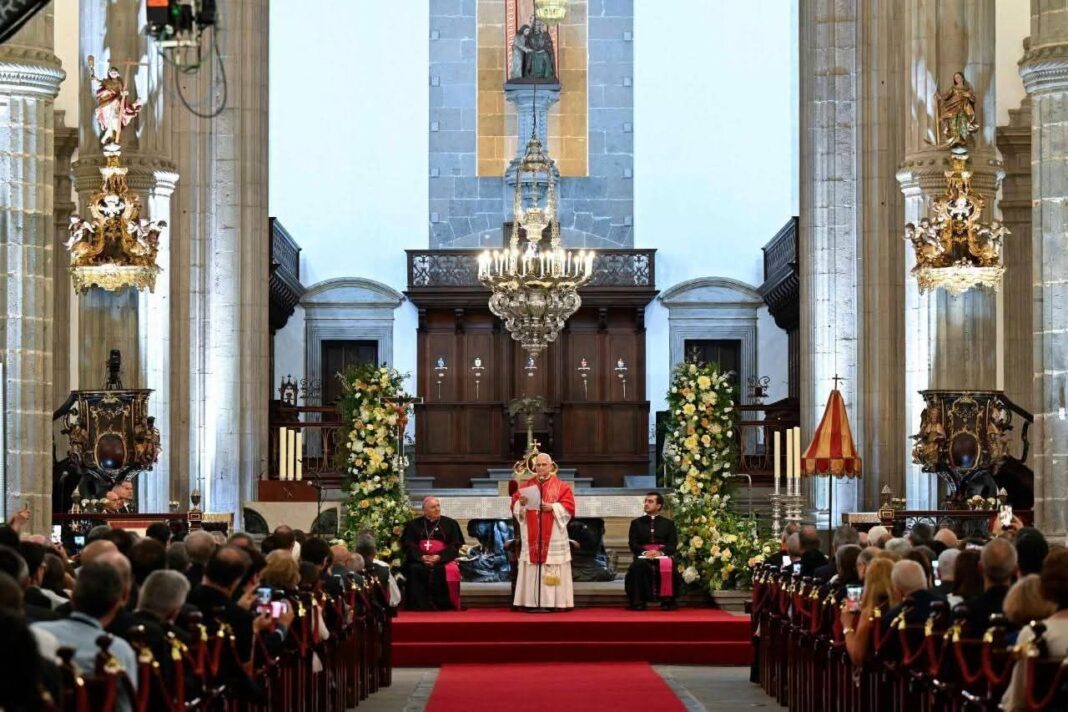

Care of the Sanctuary and Sacred Objects
There is a popular saying that “cleanliness is next to godliness.” While this expression is not found in Sacred Scripture, it reminds us of an important truth: whatever is dedicated to divine worship should be cared for with dignity and respect.
As pastors, let us ensure the regular cleaning and maintenance of:
- Sacred vessels
- Altar linens
- Vestments
- The sanctuary
- The church building
- The tabernacle area
- Liturgical books and furnishings
Everything associated with divine worship should reflect the beauty and reverence due to God.
I vividly remember removing altar linens for washing during one of my first pastoral assignments, only to be told:
“Father, we never knew the altar cloth was supposed to be washed.”
To my surprise, the altar linens had apparently remained unchanged for many years.
Such experiences remind us that proper liturgical formation is necessary not only for priests but also for sacristans, liturgical committees, and parish volunteers.
Attention to these seemingly small details contributes greatly to fostering reverence and respect for the Sacred Liturgy.
A Call to Pastoral Balance
As pastors, we must make time for every aspect of parish life, especially those things directly connected to the celebration of the Sacred Liturgy.
The Eucharist is too precious to be neglected.
Every altar cloth, sacred vessel, vestment, liturgical book, tabernacle, and sanctuary speaks silently about our love for Christ present in the Eucharist.
May every parish become a truly Eucharistic community where Christ is adored, reverenced, celebrated, and received with faith.
As our Lord Himself declared:
“I am the living bread which came down from heaven; if anyone eats of this bread, he will live forever” (John 6:51).
On Catechism
In some parts of the world today, many Catholics either leave the Church altogether or attend Mass only during Christmas, Easter, weddings, and funerals. One of the major reasons for this unfortunate reality is inadequate catechesis during their formative years.
Catechesis is not merely the transmission of religious information; it is the systematic formation of believers in the faith, helping them to know, love, and follow Jesus Christ and His Church.
The Catechism of the Catholic Church teaches:
“Catechesis is an education in the faith of children, young people and adults which includes especially the teaching of Christian doctrine imparted in an organic and systematic way” (CCC 5).
For this reason, every parish must place great importance on catechetical formation.
- The Parish, the School, and Catechetical Formation
Parishes should collaborate closely with Catholic schools and parish schools to ensure that children receive sound catechetical instruction from an early age.
Catechism classes should be properly structured and conducted over a sufficient period to adequately prepare children for the reception of the Sacraments of Christian Initiation, namely Baptism (where necessary), Confirmation, and the Holy Eucharist, in accordance with the norms established by the Episcopal Conference and the diocesan bishop.
Faith formation should not be reduced to a mere preparation for receiving a sacrament. Rather, it should help children develop a lifelong relationship with Jesus Christ and His Church.
As Sacred Scripture teaches:
“Train up a child in the way he should go, and when he is old he will not depart from it” (Proverbs 22:6).
- The Responsibility of Parents
Parents must recognise that they are the first and most important educators of their children in the faith.
The Second Vatican Council teaches that the family is the “Domestic Church,” and the Catechism further states:
“Parents have the first responsibility for the education of their children” (CCC 2223).
Therefore, parents should make it a priority to enrol their children in catechism classes and actively support their faith formation.
Unfortunately, some parents wait until the last moment before seeking admission for their children into catechism programmes, especially when a sacrament is approaching. In some cases, they expect exceptions to be made even when the required formation has not been completed.
While pastoral sensitivity is always necessary, the integrity of catechetical formation should never be compromised. Favouritism and undue exceptions can undermine the seriousness of sacramental preparation and ultimately do a disservice to both the child and the Church.
The goal is not simply to receive a sacrament but to understand, appreciate, and live the faith that the sacrament signifies.
- The Formation of Catechists and the Review of Catechetical Materials
I believe that dioceses and parishes should periodically review the duration, content, and effectiveness of their catechetical programmes.
Likewise, the formation of catechists deserves serious attention.
Catechists are among the most important collaborators in the Church’s mission of evangelisation. They do far more than teach lessons; they help form disciples of Christ.
Pope Francis, in instituting the Ministry of Catechist, highlighted the indispensable role catechists play in the life and mission of the Church.
For this reason:
- Catechists should receive adequate doctrinal, spiritual, and pastoral formation.
- Catechetical materials should be regularly reviewed to ensure doctrinal accuracy and pastoral relevance.
- Catechists should be updated on contemporary challenges affecting young people and families.
- Ongoing formation programmes should be organised to strengthen their effectiveness in ministry.
As St. Paul instructed Timothy:
“What you have heard from me before many witnesses entrust to faithful men who will be able to teach others also” (2 Timothy 2:2).
The Importance of Sound Catechesis
A parish that neglects catechesis risks producing Catholics who are sacramentalised but not evangelised, baptised but not adequately formed, and present in the Church physically but not deeply rooted in the faith.
Sound catechesis helps Catholics:
- Understand the teachings of the Church.
- Appreciate the sacraments.
- Develop a personal relationship with Christ.
- Defend and explain their faith.
- Live as authentic Christian witnesses in society.
As St. Peter exhorts:
“Always be prepared to make a defence to anyone who calls you to account for the hope that is in you” (1 Peter 3:15).
For this reason, catechesis should never be regarded as a secondary activity in parish life. Rather, it is one of the principal means through which the Church fulfils her mission of making disciples and handing on the faith from one generation to another.
May every parish invest generously in catechesis so that the faithful may grow in wisdom, holiness, and a deeper knowledge of Christ.
For as the prophet Hosea reminds us:
“My people are destroyed for lack of knowledge” (Hosea 4:6).
On RCIA: What We Have Not Realised
In the Catholic Church, the Rite of Christian Initiation of Adults (RCIA) may be organised at the parish, deanery, or diocesan level, taking candidates through the various stages of formation, from the Rite of Acceptance into the Order of Catechumens to the Scrutinies and eventual reception of the Sacraments of Initiation.
This gradual process helps candidates to appreciate the significance of each stage of their faith journey and to grow steadily in their relationship with Christ and His Church.
As the Catechism of the Catholic Church teaches:
“From the time of the Apostles, becoming a Christian has been accomplished by a journey and initiation in several stages” (CCC 1229).
However, it is rather unfortunate that RCIA is not always given the attention it deserves in some parishes. In certain places, little or no structured formation takes place, and candidates are only sent to the Cathedral for the Rite of Election, the Scrutinies, or other diocesan celebrations presided over by the Bishop.
While diocesan celebrations play an important role in manifesting the unity of the Church around the Bishop, RCIA should not be reduced to the final rites alone. The process of formation, instruction, prayer, and accompaniment is equally important.
The RCIA is not merely a programme for receiving the Sacraments. It is a journey of conversion and discipleship through which candidates come to know Christ, embrace the teachings of the Church, and participate actively in the life of the Christian community.
I humbly think that Diocesan Bishops and Episcopal Conferences should periodically evaluate the effectiveness of RCIA programmes within their jurisdictions and determine the most suitable pastoral approach for their particular circumstances.
Where necessary, clear guidelines may be provided regarding whether RCIA should be principally organised at the parish level, diocesan level, or, in some situations, at the deanery level.
In dioceses where resources are limited or where communities are widely dispersed, deanery centres may provide an effective alternative, operating under the supervision of the Diocesan Director of Catechesis, the Episcopal Delegate responsible for RCIA, or other competent diocesan authorities.
Whatever structure is adopted, the ultimate goal should remain the same: to ensure that candidates receive sound doctrinal formation, authentic spiritual accompaniment, and adequate preparation for full initiation into the Catholic Church.
The entire parish community should also recognise its responsibility in supporting RCIA candidates through prayer, encouragement, and Christian witness. The faith is not learned only in the classroom but also through participation in the life of the Church.
May our parishes continue to invest generously in RCIA, so that those seeking Christ may encounter Him fully in His Church and become committed disciples.
TOBE CONTINUED
By: Rev. Fr. Albert Kyei Danso
Chaplain, Holy Family Ghanaian Catholic Community Church,
Italy