
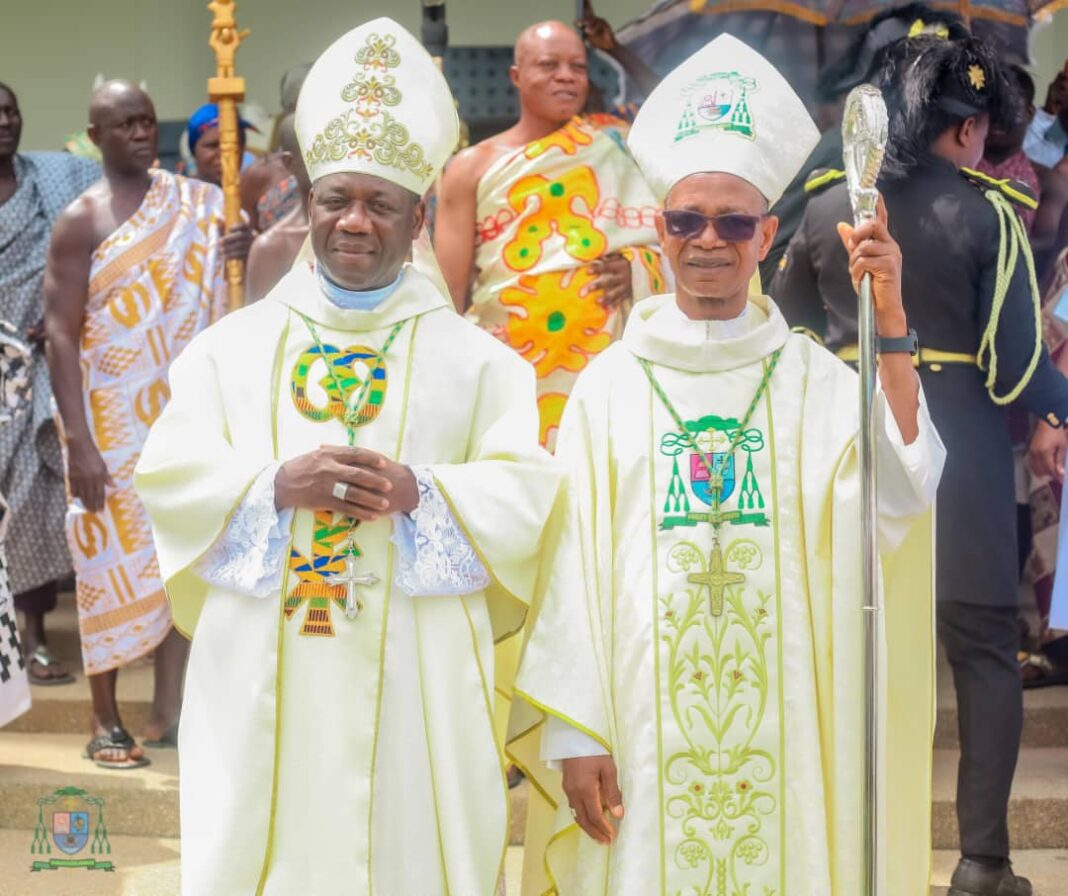

The Apostolic Nuncio to Ghana, His Excellency Julien Kabore in a homliy during the August 8, 2026 Installation Mass of the First Bishop of Donkorkrom, Most Rev. John Alphonse Asiedu, SVD, at the St. Francis Xavier Cathedral, schooled the faithful on the significance of the evolution from the title of Apostolic Vicar to the Bishop of Donkorkrom Diocese.
He explained that the term “Vicar” is derived from the Latin word “vicarius” meaning “one who acts in the place of another” otherwise called “a representative” or “a delegate”. A vicar exercises an authority entrusted to him by someone else, with emphasis not on being “second in rank”, but on acting in the name of another, as in the case of a vice-President or vice-chancellor, he said.
The prelate upheld that an Apostolic Vicar is not a temporary administrator waiting for a diocese to be established, but rather the true Ordinary of the Apostolic Vicariate, possessing ordinary, proper and immediate authority over the faithful entrusted to him. He maintained that the Bishop however exercises such office in the name of the Roman Pontiff, who has entrusted him with the pastoral care of that missionary territory.
The Nuncio likened the title of an “Apostolic Vicar” to a Parochial Vicar who assists the Parish Priest in the pastoral care of a parish, sharing in the ministry of the parish and acting in collaboration with and under the authority of the pastor, or a Vicar General who is the principal collaborator of the diocesan bishop, and by law, exercises the bishop’s executive authority throughout the diocese and could act in the bishop’s name.
He however distinguised that the Apostolic Vicar is not simply the representative of a diocesan bishop, but the representative of the Roman Pontiff in governing an Apostolic Vicariate, adding that because the territory has not yet become a diocese, the Holy Father entrusts its pastoral care to an Apostolic Vicar, who governs it in the Pope’s name.
“This does not mean, however, that an Apostolic Vicar is less of a bishop,” he buttressed, stating categorically that in most cases, an Apostolic Vicar is already an ordained bishop; one who has received episcopal ordination exactly as every Catholic bishop does.
“Bishop Alphonse Asiedu has been a full and complete Bishop for the last 7 years. What is new is the Church he is now called to shepherd: not an Apostolic Vicariate any longer but a Diocese,” he reminded.
Archbishop Kabore drew the attention of the faithful to the fact that the title “Vicar of Christ” belongs in a unique and singular way to the Pope. As the Successor of Saint Peter, the Roman Pontiff represents Christ in the visible governance of the universal Church. All other vicars in the Church derive their authority, directly or indirectly, from the offices entrusted to them within the Church’s hierarchical structure, he explained.
He drew parellels between an Apostolic Vicariate, which is a missionary territory that has not yet reached the stage of becoming a diocese, and is established by the Pope in places where the local Church is still developing, and entrusted to an Apostolic Vicar, who governs it in the name of the Pope, and a Diocese, which is a local Church that has reached a greater level of maturity, with sufficient clergy, faithful, institutions and pastoral stability to stand on its own.
“When the Holy Father judges that the time has come, he raises the Apostolic Vicariate to the dignity of a Diocese,” he explained, adding that if the Pope appoints the same bishop to lead the new Diocese, the Apostolic Vicar becomes its first Diocesan Bishop, as is the case of Donkorkrom.
In such a case, he maintained, the Bishop does not need to be ordained again because he was already a bishop. He further reiterated that what changes is not the bishop’s episcopal ministry but his canonical office. He no longer governs an Apostolic Vicariate in the name of the Pope, but becomes the proper pastor of the newly erected Diocese entrusted to his care.
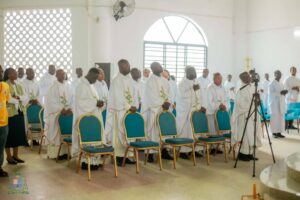
“Donkorkrom has grown from an Apostolic Vicariate into a Diocese. This is a beautiful sign that the local Church has matured and is ready to continue its mission with greater stability and responsibility,” he applauded.
The Nuncio further expounded on the reason why the liturgical celebration was an installation, and not an ordination. He explained that Most Rev. John Alphonse was already a Bishop, and that Episcopacy is conferred only once and can never be repeated, hence, the installation, which is the liturgical act by which the Bishop takes canonical possession of his diocese and begins his ministry as its diocesan bishop.
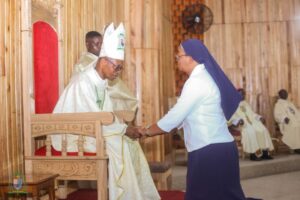
He further shed light on the central symbol of a Bishop’s installation, which is the “Cathedra”: the bishop’s chair, from which the word “Cathedral” is derived. During the ceremony, the bishop is led to the Cathedra and he takes his seat, signifying that he has assumed responsibility as the shepherd of that local Church. The installation therefore marks the beginning of his pastoral service to the diocese, not a new episcopal ordination, he explained.
“The installation of the first Bishop of Donkorkrom, therefore, does not mark the beginning of his episcopal ministry. He was already a bishop. Rather, it marks the beginning of a new chapter in the history of the local Church. An Apostolic Vicariate has become a Diocese, a visible sign that the Gospel has taken deep root, that the Church has grown in faith and maturity, and that she is ready to continue her mission as a fully established Diocese within the communion of the universal Church,” he enlightened.
By Sr. Sylvie Lum Cho, MSHR (DEPSOCOM, Donkorkrom Diocese)