
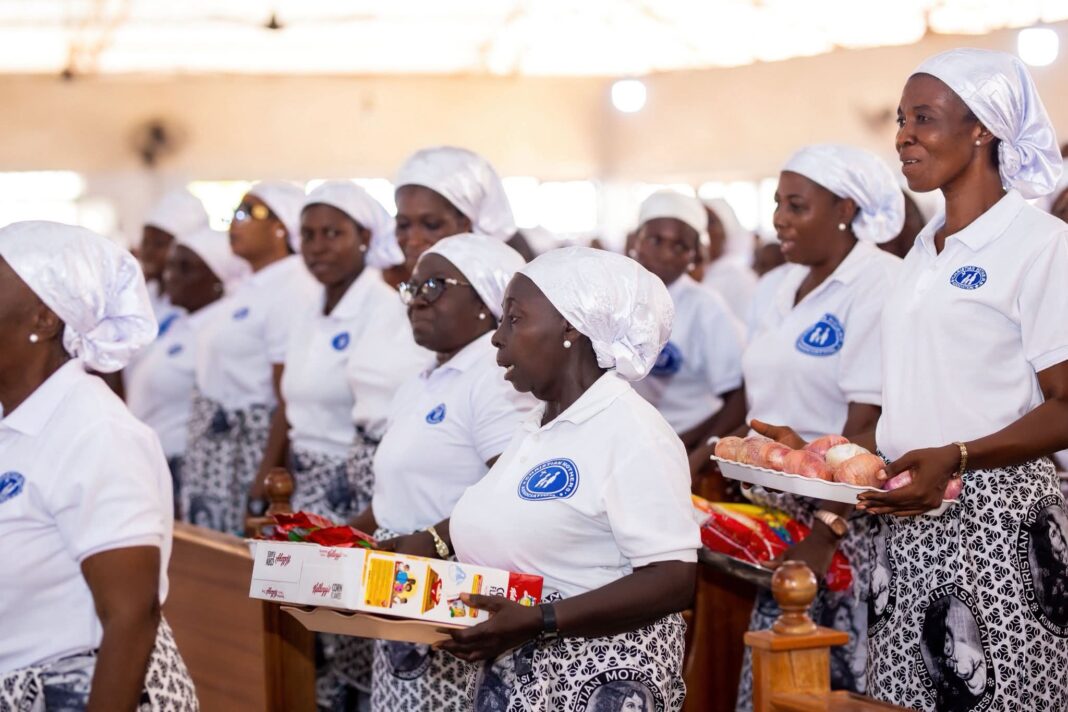

Beloved in Christ, while we sympathise with the people called Methodist, the recent confrontation on tithing between the Mmaakuo Panin and the Minister raises serious pastoral concerns:
(A) What admits one into the Church and makes one a member—is it tithing, payment of welfare dues, or baptism?
(B) What is the Christian understanding and practice of tithing, and how is it regulated as a source of income for the Church in terms of stewardship, financial management, and purpose?
(C) Are welfare or tithe-related benefits during funerals and marriages just and meaningful in relation to monthly welfare contributions?
(D) What are the consequences when a homily from the pulpit becomes inciting, provocative, or inappropriate? Who is to be blamed? Is the pulpit a place to settle scores for a minister of the Word?
The Concept of Tithing
The Christian concept and practice of tithing dates back to the Old Testament and is reflected, though not strictly imposed as a universal Church law, in the New Testament.
It involved offering one-tenth of one’s produce or income to God. In some places, it is mobilised on the first Sunday of every month in gratitude to God for His abundant blessings and as a sign of covenant between the donor and the Lord, as an act of gratitude and trust in God’s providence rather than as a guarantee of material return.
The Church in Old Testament times had different forms of tithing, and the main purpose was to support the missionary work of the Church, as well as the poor brethren and the needy.
So, while this practice of tithing is seen in the New Testament context, it is not strictly prescribed as a fixed obligation for Christians. Though some people have seriously criticised it, arguing that because Christ offered Himself once and for all on the Cross, the practice of tithing is no longer considered obligatory, the question remains: have Christians ceased to thank God with their first fruits and substance, and has the purpose for the support of the Church and the poor ceased?
In the Catholic Church, the faithful are encouraged to support the Church generously according to their means, not necessarily by a fixed percentage.
How Does One Become a Member of the Church?
Incorporation into the Methodist Church
It is said that among the sons and daughters of John Wesley, one becomes a full member of the Church the very moment one receives a Church card after being registered. From that moment, the person is obliged to partake fully in all the Church’s activities, and the rights and responsibilities of being a Church member bind him or her.
Incorporation into the Catholic Church
In the Catholic Church, membership is clearly defined by Church law. Many people mistakenly believe that regular Mass attendance, active participation, or payment of welfare dues automatically makes one a member of the Church. This is not correct. Canon 96 states: “By baptism, one is incorporated into the Church of Christ and is constituted a person in it with the duties and rights proper to Christians, insofar as they are in ecclesial communion and unless a legitimately issued sanction stands in the way.”
Canon 204 §1 further explains that the Christian faithful are those who, through baptism, are incorporated into Christ and share in His priestly, prophetic, and royal mission.
Although baptism is the primary means by which one becomes a member of the Catholic Church, it must also be noted that a person can be received into the Church through other legitimate means. This applies especially to those who, having been validly baptised in other Christian denominations, are later received into full communion with the Catholic Church.
A Brief Analysis of the Two Canons in Reference to Tithing
Both canons make it explicitly clear that one gains admission into the Church and becomes a member of the Church basically through baptism, where the convert becomes a person in the Church with rights and privileges.
The Implications
This means that the financial obligation of welfare and tithing by the newly admitted or baptised comes after the reception of baptism and the exercise of his or her rights (the privileges one enjoys as a member of the Church).
So, in the Catholic Church, giving a Christian burial or attending the funeral rites of a member does not depend on the payment of either welfare dues or tithing. The person is buried because he or she is a full member of the Church, having received the Sacraments of Christian Initiation: Baptism, Confirmation, and Holy Eucharist, and is in full communion with the Church.
In instances where some communicants (full members of the Church) are bereaved but do not pay welfare dues or tithe, the Church does not refuse to attend the funeral. Normally, members would attend, although the Church may not make a formal donation; individuals may still offer personal contributions.
It must be clearly stated that tithe money is not used for funeral or marriage donations, but such donations must come from welfare funds, where appropriate.
The Question of Tithing in the Catholic Church
Every local Church (Diocese) has ways of raising funds to support missions, the sustenance of her priests, the apostolate, and charitable works, as seen in the Code.
This means that, though in the African Church the idea of tithing is more commonly practised in Protestant and Charismatic Churches, the Catholic Church and other Orthodox Churches can also make good use of it.
Though some parishes in Ghana take tithe, some do not. This raises pastoral concerns for the Diocesan Bishop to regulate with a decree, making it a diocesan policy for every parish in his Diocese, indicating what percentage goes to the Diocese, the parish, and the priests in that parish.
I am of the view that, for uniformity’s sake, it should either be taken in all the parishes in the Diocese or not taken at all.
How Income from Tithe is Utilised and Accounted For
As pastors who are stewards of the temporal goods of the Church, every dollar received must be accounted for and channeled to the appropriate quarters or project.
Though most dioceses have no specific pastoral guidelines concerning the use of the proceeds from the tithe, many pastors use it for projects in the parish. The Local Ordinaries could consider national or diocesan pastoral guidelines on how proceeds from the tithe should be used in the parish.
The Concept of Welfare Dues in the Church
It is rather unfortunate that a good number of Catholics, especially those in the diaspora, attend societies and the Church in general not because of pastoral guidance and accompaniment, but because of welfare benefits when they wed, lose a relative, or are seriously ill.
To such parishioners, welfare is a kind of savings or investment. Such people are of the view that “No contribution, no benefit,” meaning that once one does not contribute, even when in need or seriously ill, the Church must not support them.
Sometimes, it becomes sad when some baptised Catholics quit the Church simply because they did not receive welfare benefits, or no one visited them in the hospital.
Another serious challenge is when some rich parishioners contribute heavily during harvest but leave the pastor in a difficult position when bereaved and still expect welfare benefits.
On the other hand, there is the situation of the aged, the sick, and the unemployed. Some may have contributed when they were active and healthy, but the moment they are unable to pay, pastoral discretion is often applied, although this sometimes creates tension when relatives are financially capable.
Overcoming the Welfare Trap as a Church
In the viral video, one sees the woman expressing her displeasure at the small amount of funeral and marriage benefits after years of paying welfare and tithe.
A comparative study of the welfare systems of Pentecostal and Charismatic Churches and that of the Orthodox Churches, including the Catholic Church, reveals a significant gap and the need for reform.
There is therefore the need to design a national or diocesan welfare policy for the laity, priests, and religious under competent ecclesiastical authority.
I humbly challenge the leadership of the National and Diocesan Laity Council to come out with a reviewed, standard, and common welfare policy approved by the competent ecclesiastical authority.
The Pulpit, Not A Place to Settle Scores
The pulpit or lectern is sacred and is for the preaching of the Word of God. Therefore, the homily must unite and not divide; it must encourage and not discourage. It must be polite and not impolite or arrogant, inclusive and not exclusive, because the preacher also preaches to himself and not only to the laity.
The homily must not be provocative but should be correct with pastoral wisdom, prudence, and diplomacy. It must be beneficial to every member of the faithful with particular pastoral needs in the Church.
The widow or widower must have his or her message; the sick, the hopeless, and the afflicted must be consoled; couples in marriage crisis must receive reconciliation; the jobless tertiary graduate must be given hope; new converts and Sunday school children must be taught; and the single must also be addressed.
In other words, it must be cross-cutting and well prepared. When a pastor prepares very well and prays through his homily, he has more than enough message to share, and no amount of time will be enough for him; therefore, he will not resort to throwing shades.
I remember very well when I was a seminarian, I had the opportunity to serve in a village near Barekese where their small church virtually had only one bulb. Having stayed there and raised some funds from friends in the city, the pastor at the time granted me permission to rewire and fix bulbs in the chapel, which I did with my late catechist and father, the late Mr. Dominic Nkrumah, since he was a retired electrician.
Upon completion, this controversial junior catechist entered the church furious, thinking I had used their church money for the wiring.
It was time for the Morning Communion Service, and I remember my Charismatic leader coming to me and saying, “Fr, when you climb the sanctuary during the homily, give it to them.” I laughed!
Beloved in Christ and venerable brothers in the ministry, as the current Presiding Bishop of the Methodist Church, Most Rev. Prof. Asamoah Gyedu, puts it, “The pulpit is not a place to settle scores.”
If, as a pastor, you have a problem with your church leaders or members, it would be pastorally wise and prudent to find an appropriate place and occasion to address the matter respectfully and amicably.
If the pastor had not used provocative utterances, the woman would not have retaliated. “If nothing touches the palm branches, it does not rattle.” Thank God, through the wise leadership of the Presiding Bishop of the Methodist Church, the poor believer seeking Jesus with her temperament has been pardoned and reconciled with her pastor.
As secularism gradually creeps into our African world, let us, as lay faithful, learn to respect, love, and live harmoniously with our pastors and priests, as they do the same for the lay faithful whom we are called to serve.
Conclusion
As the saying goes, “To be forewarned is to be forearmed.” This situation serves as an important pastoral lesson—not only for the Methodist Church but for the Catholic Church and other Christian communities as well.
There is a need to deliberate on it and revise our approaches for the good of the lay faithful. I humbly challenge the National and Diocesan Laity Council to consider designing a better, standard, and common welfare system or policy for the Church in Ghana. Once this is done, people will not hide behind welfare issues to leave the Church.
There is an article in the media that was attributed to one of our Ghanaian Catholic Bishops, which is not his work, and gives a false impression.
When it comes to contribution in the Catholic Church, it has two sides according to the Code of Canon Law: it is an obligation and also an encouragement/recommendation for the lay faithful to do so, which the Diocesan Bishop or the Episcopal Conference may impose. After all, the Church is both a Divine and a Human Institution: Divine Laws meet Ecclesiastical/Church laws.
Since the Pope could dispense Divine Laws in a critical and meaningful pastoral situation, so can the Church, with the permission of the Vicar of Christ, also impose a tithe or any other tax, even if it is not Divine, though tithing is!
Let us not forget that the Church is not only biblical, legalistic/canonical, and spiritual, but also pastoral.
Thank you very much.
By: Rev. Fr. Albert Kyei Danso
Chaplain,
Holy Family Ghanaian Catholic Community Church,
Italy.